
Renovation Loan Austria 2026: Interest Rates, Subsidies & Tips for Expats
Renovation Loan in Austria 2026: Financing, subsidies, and energy efficiency – the complete guide for expats looking to buy property in Austria. Learn about different loan types, federal and provincial subsidies, and essential tips for your property loan Austria.
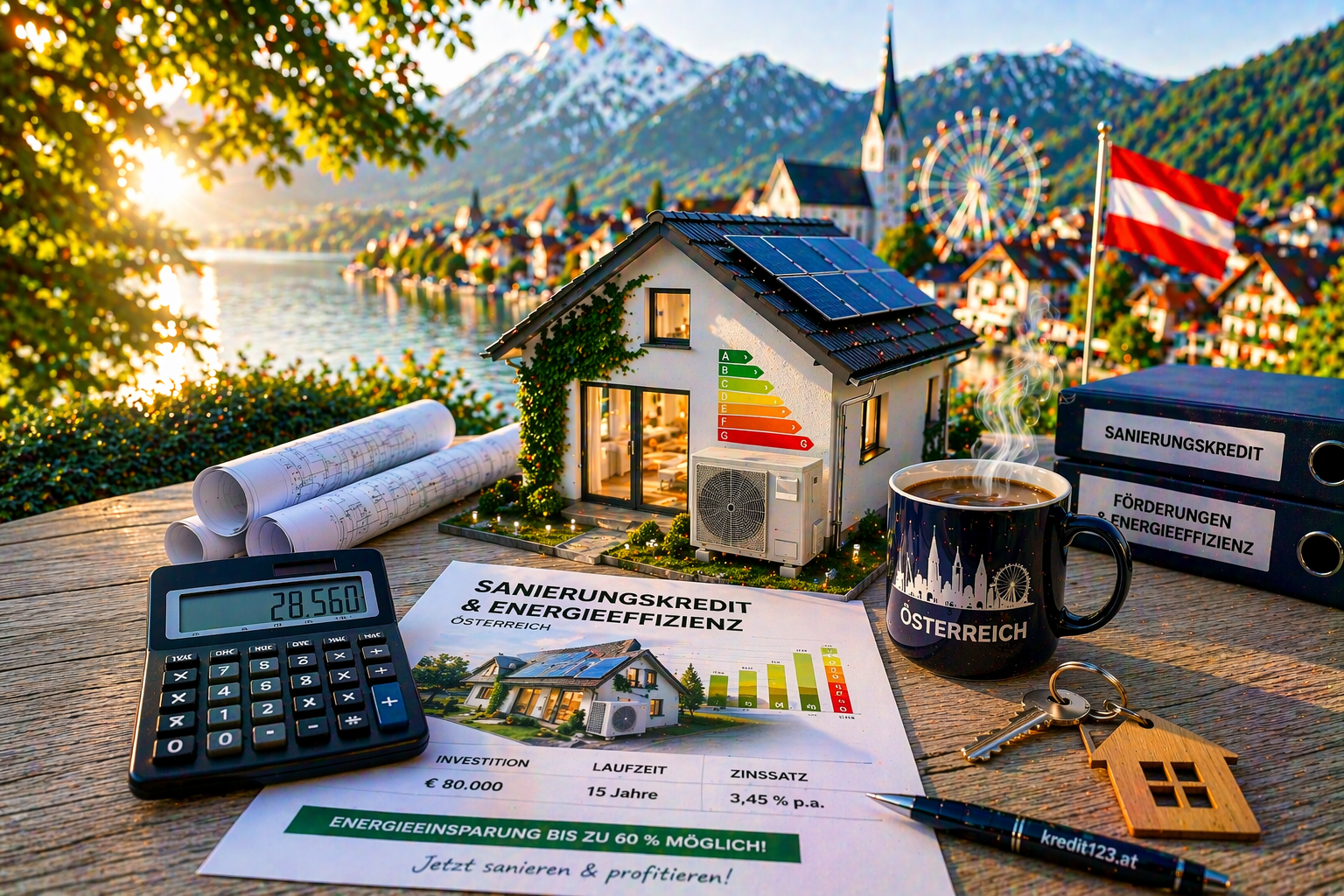
Renovation Loan in Austria 2026: Financing, Subsidies, and Energy Efficiency – The Complete Guide for Expats
kredit123.at · Guide · Topic: Renovation Loan Austria, Thermal Renovation Subsidy, Financing a Heat Pump, Loan for Renovation without Land Register Entry · Status April 2026
Rising energy costs, outdated heating systems, and the pressure for an energy transition – more and more property owners in Austria are facing the question of how to renovate and modernize their homes. The good news for expats looking to buy property in Austria: there are more subsidies, more affordable loans, and better combination options available than many realize.
The challenging news: The system is complex, deadlines are tight, and incorrect planning can lead to losing out on subsidy claims. This guide explains everything – comprehensively, up-to-date, and without oversimplification. If you start your property loan comparison / renovation loan process now, you'll quickly find the right foundation for your project, making your mortgage Austria journey smoother.
Why Renovation is More Relevant Than Ever in 2026 for Expats in Austria
Austria's building stock is aging. Approximately 60 percent of all residential buildings were constructed before 1980 – that is, before modern energy standards, before thermal insulation regulations, and before today's awareness of energy efficiency. Many of these buildings are heated with oil or gas, have uninsulated facades, old windows, and outdated heating systems.
This has concrete consequences: high energy costs for residents, high CO₂ emissions for the environment, and increasing pressure from European efficiency directives, which could become binding for existing properties in the medium to long term. This is particularly relevant for expats considering a property loan Austria for an older home.
At the same time, 2026 offers a dense network of subsidies – federal subsidies, provincial subsidies, and favorable promotional loans – which can significantly reduce the cost of renovation measures. Those who utilize this correctly will not only permanently lower energy costs but also measurably improve their property's value. Before you start, you should calculate the ancillary costs to precisely plan your budget when you buy property Austria.
What is a Renovation Loan – and What Isn't
The term 'Sanierungskredit' (renovation loan) is not used uniformly in Austria. It describes various financing products that differ significantly in structure, costs, and requirements.
Type 1: Unsecured Renovation Loan (Consumer Loan)
A standard loan without 'Grundbuch' (land register) collateral – similar to a consumer loan, but earmarked for renovation measures. No mortgage, no notary, no land register fees. This can be an option for expats seeking an expat mortgage for smaller projects.
Advantages: Fast, straightforward, no 'Grundbuch' (land register) processing required.
Disadvantages: Higher interest rates than a mortgage-backed loan, maximum available amount generally limited – depending on the institution, up to approx. 75,000 to 100,000 Euros.
Suitable for: Smaller and medium-sized renovation projects such as window replacement, bathroom renovation, new heating system, insulation measures up to a certain volume.
Type 2: Mortgage-Backed Renovation Loan
A loan with a 'Grundbuch' (land register) lien – either as an increase to an existing mortgage loan or as an independent new loan with a mortgage on the property. This is a common form of real estate financing Austria.
Advantages: Lower interest rate than an unsecured loan, higher loan amounts possible, longer maturities.
Disadvantages: 'Grundbuch' (land register) processing required (costs approx. 1.2% of the loan amount for lien registration), more effort, notary appointment.
Suitable for: Comprehensive renovations, full renovations, combinations of several measures with a higher total volume. Here, it is often worthwhile to consider refinancing to bundle old debts with new renovation goals, especially for an expat mortgage.
Type 3: Subsidized Renovation Loan (Housing Promotion)
A low-interest loan granted within the framework of the housing promotion of the respective Austrian federal state. These loans often have significantly lower interest rates than market loans and can be combined with bank loans.
Advantages: Lowest interest rate, often below market conditions, partly non-repayable grants.
Disadvantages: Income limits, eligible measures defined, application required before construction begins, processing time several months.
Suitable for: Energy-efficient renovations that meet the requirements of the respective subsidy program. This is a key aspect of property loan Austria for expats.
The Subsidy Landscape in Austria 2026 – A Complete Overview for Expats
The subsidy system in Austria is complex – the federal government and the federal states each have their own programs, which sometimes overlap and sometimes complement each other. Here is a structured overview.
Federal Level: The Most Important Programs
The Federal Ministry for Climate Action promotes thermal renovation measures and heating system replacement through Kommunalkredit Public Consulting (KPC). The programs are re-issued annually – budgets are limited and allocated on a first-come, first-served basis. This is crucial for expats planning to buy property Austria and renovate.
Measure | Subsidy Type | Typical Amount |
|---|---|---|
Facade Insulation | Investment Grant | 20–30% of eligible costs |
Roof / Ceiling Insulation | Investment Grant | 20–30% |
Window Replacement (Thermal Glazing) | Investment Grant | 15–25% |
Heating System Replacement with Heat Pump | Investment Grant + Bonus | up to €7,500 flat-rate bonus possible |
Heating System Replacement with Biomass/Pellets | Investment Grant | 20–30% |
Connection to District Heating | Investment Grant | depending on region |
Photovoltaic System | Separate Subsidy Program | via OeMAG feed-in tariff |
Subsidy amounts and conditions change annually. Always inquire about the current status with KPC (umweltfoerderung.at) – before commissioning any measures.
Most Important Rule: Federal subsidies must be applied for before the start of the measures. Anyone who commissions work first and then applies for a subsidy will, in most cases, have lost their claim. This is not a mere formality – it is a common and costly mistake for expats navigating real estate financing Austria.
Get Out of Oil and Gas – Subsidy Bonus
Those who switch from a fossil heating system (oil, gas, coal) to a renewable system can receive an additional bonus. This so-called 'Raus-aus-Gas-Bonus' (Get Out of Gas Bonus) has been anchored in various subsidy programs and will continue to be available in 2026 – budgets and exact conditions should be inquired about for the current program status.
Provincial Level: Housing Promotion of the Federal States
Each of the nine federal states (Bundesländer) has its own housing promotion system with specific programs for renovation. The differences are considerable – both in terms of income limits and eligible measures and the form of subsidy. This is an important consideration for expats seeking an expat mortgage or property loan Austria.
Federal State | Renovation Subsidy Instrument | Special Feature |
|---|---|---|
Vienna | Housing Renovation Promotion | Grants for thermal renovation, heating system replacement |
Lower Austria | Lower Austria Housing Promotion Renovation | Low-interest loans, income limits |
Upper Austria | Upper Austria Housing Promotion | Energy Bonus Point System, Grants |
Styria | Styrian Housing Promotion | Annuity grants, eco-points |
Salzburg | Salzburg Housing Promotion | Loans and grants, energy efficiency obligation |
Tyrol | Tyrolean Housing Promotion | Renovation grant, strict energy standards |
Carinthia | Carinthian Housing Promotion | Renovation loans, direct grants |
Burgenland | Burgenland Housing Promotion | Renovation aid, heating system bonus |
Vorarlberg | Vorarlberg Housing Promotion | Energy performance certificate requirements, climate bonus |
Conditions, income limits, and subsidy amounts change regularly. Always inquire about the current status with the respective provincial housing fund – before construction begins.
Combination of Federal and Provincial Subsidies for Expats
Federal and provincial subsidies can often be combined – this is explicitly allowed and intended by the funding agencies. A well-planned renovation can thus tap into multiple funding sources simultaneously, which is excellent news for expats looking into real estate financing Austria.
Example of a possible funding structure for a comprehensive thermal renovation:
Federal subsidy for thermal renovation: Investment grant for insulation and window replacement
Federal bonus for heating system replacement: Flat-rate bonus for a heat pump
Lower Austria provincial subsidy: Low-interest loan for remaining financing
Bank loan for the non-subsidized remainder – a typical mortgage Austria component.
The exact combinability depends on the specific program – some federal and provincial subsidies may not be applied to the same measure. This must be checked on a case-by-case basis.
The Most Important Renovation Measures and Their Economic Efficiency
Measure 1: Thermal Insulation (Facade, Roof, Cellar)
The supreme discipline of energy-efficient renovation. A well-insulated building envelope permanently reduces heating energy demand, regardless of the heating system. This is a crucial step for expats aiming to reduce long-term costs after they buy property Austria.
Costs: Facade insulation approx. 100 to 200 Euros per m² of facade area including installation. For a single-family house with 200 m² of facade area: 20,000 to 40,000 Euros.
Savings: Depending on the initial state, 20 to 50 percent of heating costs. With 2,000 Euros in heating costs per year: 400 to 1,000 Euros in annual savings.
Amortization: Without subsidies, 20 to 40 years – significantly shorter with subsidies.
Recommendation: Insulation makes particular sense when the heating system is replaced at the same time. A well-insulated shell reduces the necessary heating capacity – allowing for smaller and cheaper heat pumps or boilers.
Measure 2: Window Replacement
Replace old single or double glazing with modern triple glazing. This simultaneously improves thermal insulation, sound insulation, and living comfort.
Costs: Approx. 800 to 1,500 Euros per window unit including installation. For 15 windows: 12,000 to 22,500 Euros.
Savings: 10 to 20 percent of heating costs – depending on the proportion of window area to the building envelope.
Special Feature: Window replacement as a single measure is often only subsidized by funding programs if other measures are carried out simultaneously or a minimum energy saving proof is provided.
Measure 3: Heating System Replacement – Heat Pump
The heat pump is the most subsidized and most discussed heating system in Austria in 2026. It extracts heat from the outside air, the ground, or groundwater and converts it – using electricity – into heating energy. This is a key consideration for real estate financing Austria for modern homes.
Costs: Air-to-water heat pump including installation approx. 15,000 to 30,000 Euros. Geothermal heat pump approx. 20,000 to 40,000 Euros.
Operating Costs: Significantly cheaper than oil or gas – with current electricity prices and a COP (efficiency) of 3 to 4, approx. 60 to 70 percent lower energy costs than a comparable oil heating system.
Prerequisites: A heat pump works best in well-insulated buildings with underfloor heating or low-temperature radiators. In poorly insulated old buildings with old radiators, efficiency is limited – here, insulation should be optimized first.
Subsidy 2026: Combination of federal bonus for heating system replacement and provincial subsidy possible – depending on the federal state, up to 10,000 to 15,000 Euros in total subsidies may be possible. This can significantly reduce your mortgage Austria burden.
Measure 4: Photovoltaic System
A PV system on the roof produces electricity for self-consumption and feeds surpluses into the grid. It is particularly economical in combination with a heat pump or an electric car.
Costs: Approx. 1,200 to 2,000 Euros per kWp of installed capacity. A typical system for a single-family house with 8 to 10 kWp: 10,000 to 18,000 Euros.
Savings: With high self-consumption and current electricity prices, amortization in 8 to 12 years – without subsidies. Significantly shorter with subsidies.
Subsidy: Investment grants through federal state funding programs and OeMAG feed-in tariffs for grid injection. Here too: submit the subsidy application before installation.
Measure 5: Bathroom Renovation and Apartment Renovation
Not every renovation is energy-motivated. Bathroom renovations, floor renewals, kitchen remodeling, or general improvements in living quality are also worth financing – but are generally not covered by energy-related funding programs. For these, an expat mortgage or property loan Austria might be needed.
For these measures, an unsecured renovation loan or an increase in the existing mortgage loan may be considered. If you are still unsure whether the effort is worthwhile, you can use the Rent or Buy? calculator to evaluate the long-term investment.
Financing Strategies: How to Best Combine Subsidies and Loans for Expats
This is the core of renovation financing – and the area where most mistakes occur. Understanding this is vital for securing a good mortgage Austria.
Strategy 1: Subsidies First, Loan for the Rest
The most common and often most sensible approach: Apply for all available subsidies, deduct approved subsidy amounts from the total costs, and only finance the remaining amount through a bank loan.
Process:
Submit subsidy applications (federal and provincial) – before commissioning the measures.
Await subsidy approval.
Commission and carry out measures.
Take out a bank loan for the non-subsidized volume – this is where your property loan Austria comes in.
Receive subsidy payments after completion and inspection.
Important: Months can pass between application and payment of subsidies. Tradespeople must be paid in the meantime. This requires either equity or an interim credit line.
Strategy 2: Provincial Subsidy Loan as Basic Financing
If the provincial housing fund offers low-interest loans, this is often the cheapest financing option – with interest rates below market rates. This loan forms the basis, and a bank loan is only taken out for the uncovered volume. This can be a significant part of your expat mortgage strategy.
Strategy 3: Increasing an Existing Mortgage Loan
If a mortgage loan is already running on the property and there is sufficient collateral margin, increasing this loan is often the simplest and most cost-effective option for real estate financing Austria.
Advantage: No new 'Pfandrecht' (lien) necessary – existing mortgage is extended. No additional 'Grundbuch' (land register) registration fee in many cases.
Strategy 4: Equity plus Small Loan
Those with sufficient equity can also finance the renovation fully or largely from their own funds and only take out a small loan – or forgo a loan entirely. This reduces the need for an expat mortgage.
What a Renovation Loan Costs – and What It Doesn't
Interest Rate 2026
For unsecured renovation loans, interest rates in Austria in 2026 range between approx. 4.5 and 7.0 percent effective, depending on the institution and creditworthiness. This is significantly more expensive than a mortgage-backed loan. Expats should be aware of these rates when considering a property loan Austria.
For mortgage-backed renovation loans, similar conditions apply as for normal property loans – approx. 3.0 to 4.5 percent effective, depending on the model. This is the typical range for a mortgage Austria.
Subsidized provincial loans can be significantly lower – in some federal states, one to two percent or even interest-free.
Ancillary Costs of a Renovation Loan
Cost | When Incurred |
|---|---|
Lien Registration 1.2% of loan amount | Only for mortgage-backed loans (Grundbuch entry) |
Notary Fees approx. €500–€1,500 | Only for mortgage-backed loans |
Processing Fee 0–1% | Depending on the institution |
Appraisal Fee €500–€1,500 | For re-evaluation of the property value |
For an unsecured renovation loan, the 'Grundbuch' (land register) related costs are eliminated – this is a real advantage for smaller volumes, as the effort and costs are significantly lower.
Energy Performance Certificate: Obligation and Planning Basis
The Energieausweis (Energy Performance Certificate) is mandatory in Austria for the sale, rental, and new construction of buildings. It classifies a building's energy efficiency on a scale from A++ (very good) to G (very poor). This is a key document when you buy property Austria.
For renovation planning, the Energy Performance Certificate is more than just a mandatory exercise: it shows where the greatest savings potential lies, which measures will most strongly improve the overall classification, and which sequence of measures is energetically sensible. Some funding programs require an Energy Performance Certificate before and after renovation as proof of efficiency improvement. An Energy Performance Certificate for a single-family house typically costs 300 to 800 Euros, depending on the effort and provider.
Common Mistakes in Renovation Financing for Expats
Mistake 1: Applying for subsidies too late. This is the most common and most expensive mistake. The sequence is always: subsidy application – approval – commissioning – execution – subsidy payment. This applies to any property loan Austria with subsidy components.
Mistake 2: Only applying for federal subsidies and forgetting provincial subsidies. Both can often be combined – the total subsidy is thus significantly higher. Expats should research both federal and provincial programs for their expat mortgage.
Mistake 3: Individual measures instead of a comprehensive concept. Those who replace windows today, insulate next year, and change the heating system the year after will pay tradespeople costs three times and may lose subsidy claims.
Mistake 4: Installing a heat pump without sufficient insulation. A heat pump in a
Ready to explore your options for a renovation loan or mortgage in Austria? Contact us today for personalized advice on real estate financing Austria and how to navigate the subsidy landscape as an expat. Let us help you find the best property loan Austria for your renovation project.
Useful Tools for Your Financing
Related Articles

Buying Property in Austria for Families in 2026: Leveraging an Inheritance
Buying Property in Austria for Families in 2026: With a small inheritance or family support, you can achieve homeownership. Learn how to leverage these funds for your expat mortgage in Austria.
Read more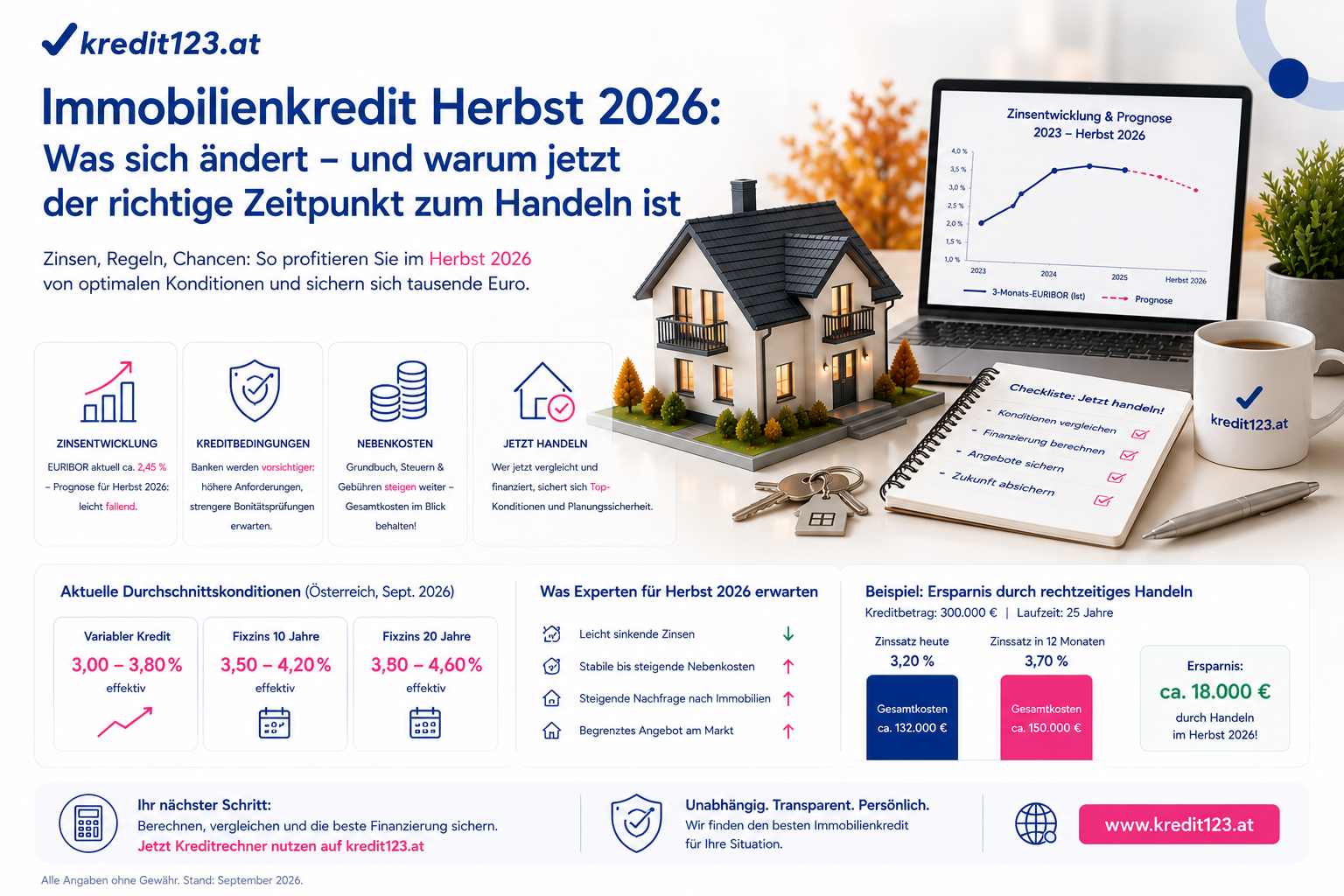
ECB Interest Rate Decision Sept. 2026: Implications for Home Loans in Austria
ECB Interest Rate Decision September 2026: What it means for your property loan in Austria. Stay informed about EURIBOR, current mortgage rates, and how to optimize your expat mortgage.
Read more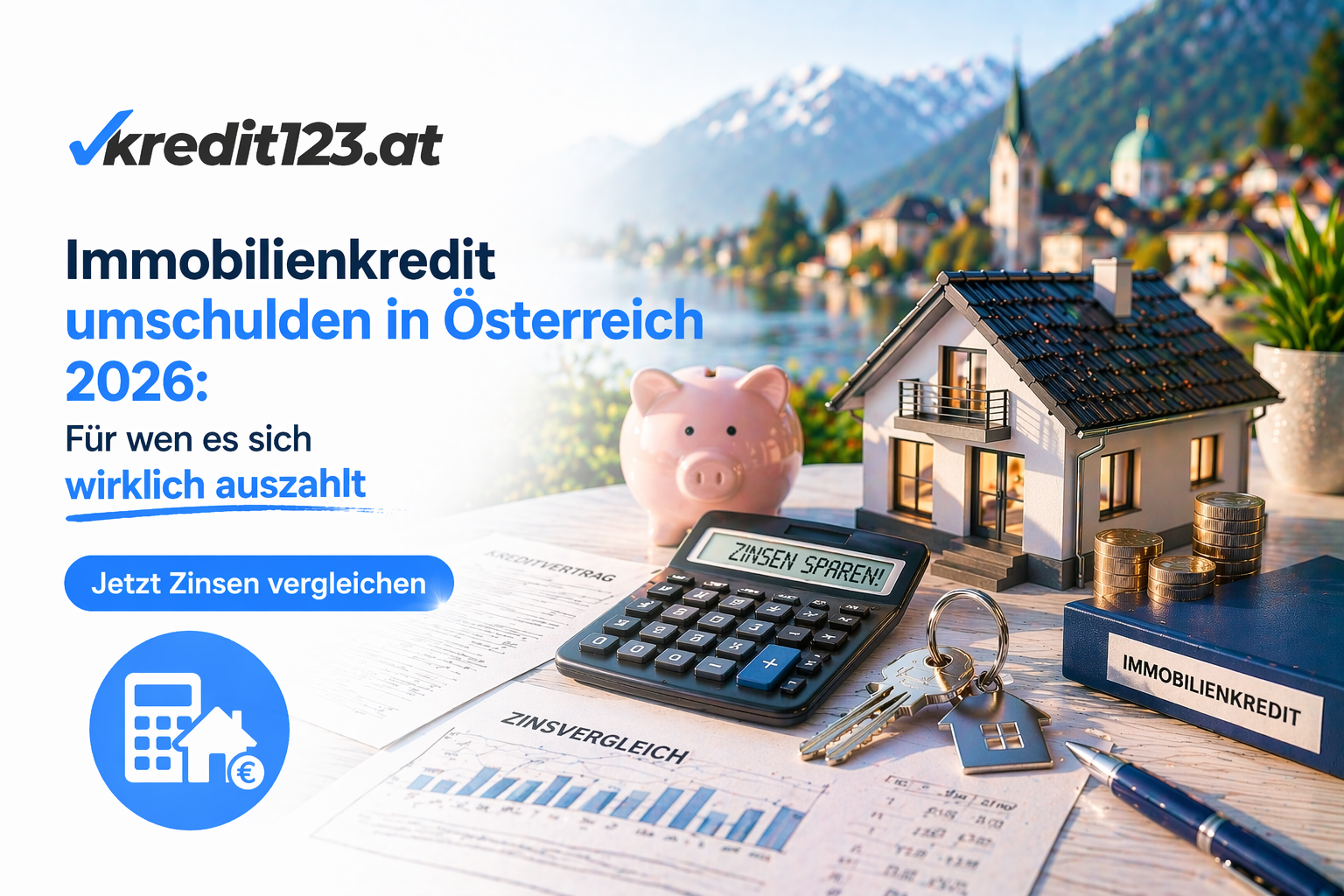
Immobilienkredit umschulden Österreich 2026: Zinsen & Tipps
Immobilienkredit umschulden in Österreich 2026: Für wen es sich wirklich auszahltkredit123.at · Ratgeber · Thema: Umschuldung Immobilienkredit Österre...
Read moreQuestions about your financing?
Our experts advise you personally and find the optimal solution for your property financing in Austria.