
Property Financing for International Organization Staff in Vienna 2026
Property financing for international organization staff in Vienna: The complete guide for 2026. If you are an employee of the United Nations, IAEA, EIB, or another international organization in Vienna and want to buy property or secure a mortgage, this guide explains the challenges and solutions for expat mortgages in Austria.
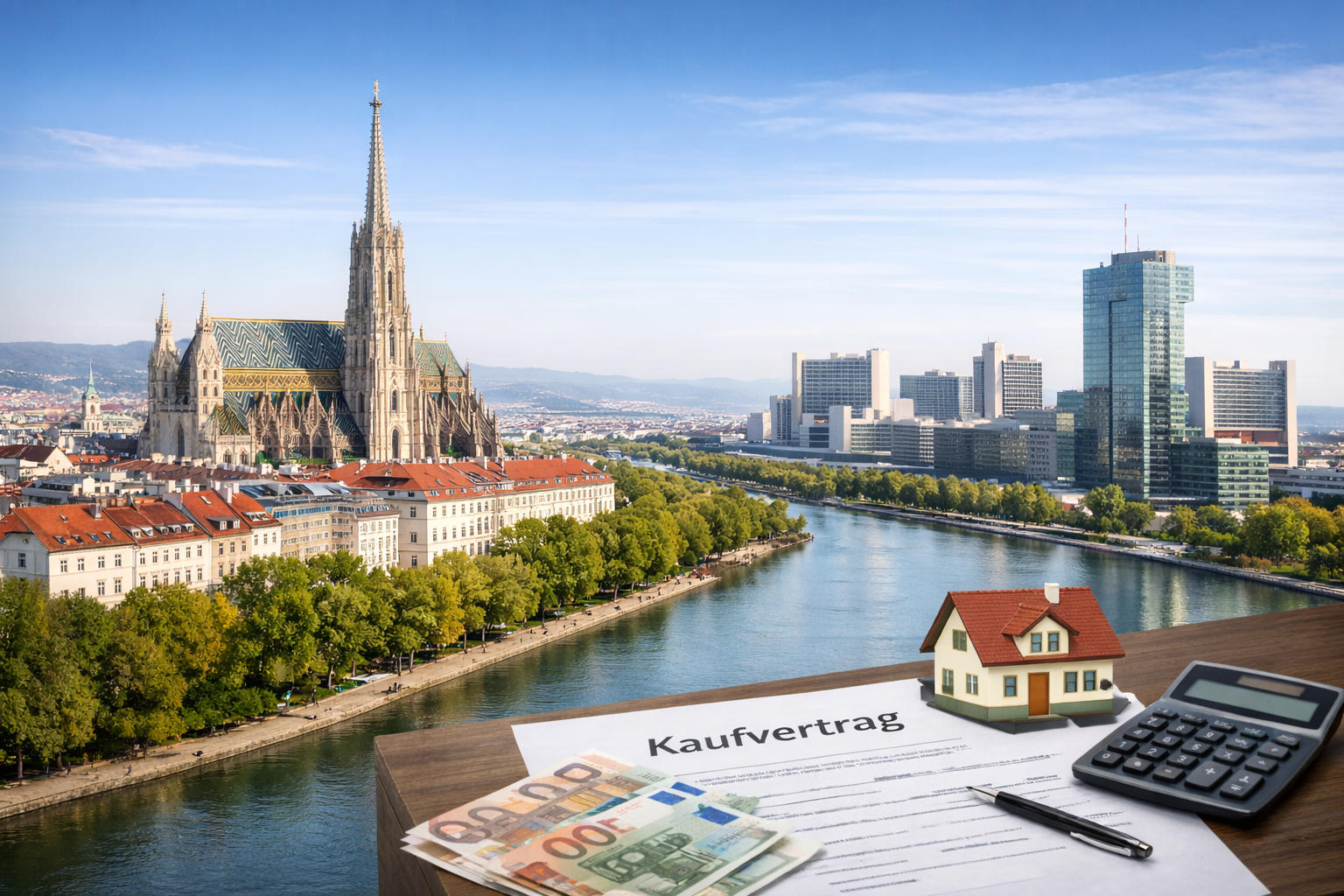
Property Financing for International Organization Staff in Vienna: The Complete Guide 2026
If you are an employee of the United Nations, the International Atomic Energy Agency, the European Investment Bank, or another international organization in Vienna and wish to buy property in Austria or secure mortgage Austria, you might encounter a situation that often overwhelms Austrian banks. Diplomatic status, tax-exempt income, foreign salary structures, immunity – all these factors complicate standard loan approvals. This article explains what matters, what the legal framework entails, and how real estate financing Austria can still be successful.
Who is this for? The Key International Organizations in Vienna
Vienna is the third-largest UN hub globally, after New York and Geneva, and hosts numerous international organizations. Several thousand international staff members work at the Vienna International Centre (VIC) in Kaisermühlen alone, in addition to staff from diplomatic missions worldwide.
The most important employers in the field of international organizations in Vienna for an property loan Austria:
United Nations Vienna (UNV / UNOV): The UN Office in Vienna includes UNODC (United Nations Office on Drugs and Crime) and UNIDO (United Nations Industrial Development Organization). Staff typically hold international civil servant status with diplomatic privileges.
International Atomic Energy Agency (IAEA): The IAEA employs approximately 2,500 staff from over 170 countries. Salaries are paid in US dollars, are exempt from Austrian income tax, and follow the UN Common System.
Organization for Security and Co-operation in Europe (OSCE): The OSCE is headquartered in Vienna and employs several hundred international staff.
Comprehensive Nuclear-Test-Ban Treaty Organization (CTBTO): Also located at the VIC, with a similar salary and status structure to the IAEA.
European Investment Bank (EIB): The EIB is headquartered in Luxembourg but maintains offices in Vienna. EIB staff enjoy EU civil servant status with their own salary structure.
Diplomatic Missions and Embassies: Vienna is home to numerous embassies and multilateral missions. Diplomats are protected by the Vienna Convention on Diplomatic Relations (1961).
EU Institutions and EU Officials: EU officials do not pay national income tax but rather their own EU tax. Their income is tax-exempt in Austria.
The Central Challenge: Why Banks Hesitate with Property Loans
The issue is not the income – international staff generally earn very well. The problem lies in the structure of this income and the legal status of the individuals concerned when seeking real estate financing Austria.
Tax-exempt income is assessed differently by banks. Austrian banks are accustomed to evaluating income based on payslips, tax assessments, and social security statements. For UN or IAEA staff, there is no Austrian payslip, no tax assessment from the tax office, and often no Austrian social security number. Some banks simply don't know how to handle this.
Diplomatic immunity creates enforcement problems. A bank granting a loan wants to be able to enforce its claim if necessary. For individuals with diplomatic immunity, this is legally restricted – while the land charge (mortgage) on the property remains, personal liability is more difficult to enforce. This increases the perceived risk for the bank.
Fixed-term contracts and mobility. Many international staff work on fixed-term contracts (P-contracts at the UN, often two to four years, renewable). Austrian banks prefer indefinite employment relationships. A fixed-term contract – even if it has been extended for years in practice – is an obstacle for many standard loan models.
Income currency. IAEA and UN salaries are often paid in US dollars, even if staff live in Vienna. This creates a currency risk that banks must – or want to – consider in the loan agreement.
Legal Foundations: What Applies to International Staff in Austria?
Tax Law
Staff of international organizations such as the UN, IAEA, OSCE, and CTBTO pay no income tax on their official salaries in Austria. This is regulated by the respective headquarters agreement between Austria and the organization – in the case of the UN, for example, by the Convention on the Privileges and Immunities of the United Nations (1946), to which Austria is a party.
This means that net income is effectively higher than comparable Austrian salaries because no national tax is deducted. For borrowers, this is an advantage – if the bank correctly assesses it. EU officials pay their own EU tax instead of Austrian income tax, which is significantly lower. Here, too, net income is structurally higher.
Important for loan documentation: Since no Austrian tax assessment exists, proof of income must be provided differently – for example, through official salary confirmations from the organization, bank statements, and possibly a confirmation from the HR department.
Social Security
International staff are generally not covered by Austrian social security. They have their own health and pension systems through their organizations. This means there is no Austrian social security statement to serve as proof of income. This is also unfamiliar territory for many banks when it comes to a property loan Austria.
Diplomatic Status and Vienna Convention
Diplomats and accredited embassy staff enjoy immunity under the Vienna Convention on Diplomatic Relations (1961). This includes civil immunity to a certain extent – protection from bailiffs and lawsuits.
For real estate financing Austria, this means that the land charge (mortgage) on the property is generally possible and provides real security for the bank. However, personal enforcement of claims against the diplomat themselves is restricted. Some banks therefore refuse, while others consider the property to be sufficient collateral.
Right of Residence and Property Acquisition
International staff in Vienna reside legally based on their employment contract and accreditation by the Austrian Ministry of Foreign Affairs. They can buy property in Austria and be registered in the Grundbuch (land register) – there are no special regulations restricting acquisition. Property rights apply without limitation.
The Grundbuch in Austria is public and reliable. A lien (mortgage) registered in the Grundbuch is a real security instrument even against persons with immunity – the property can be realized in case of default, even if personal legal action is difficult. Use our ancillary costs calculator to accurately calculate the fees.
Typical Financing Strategies for International Staff
Strategy 1: Austrian Bank with Experience in the Segment
Not all Austrian banks are the same. Some institutions – particularly in Vienna – have many years of experience with international staff and have developed their own internal assessment models. These banks know how to classify tax-exempt UN income, which documents to accept instead of payslips, and how to value the property as collateral.
The key is not to indiscriminately inquire with banks (this burdens KSV inquiries), but to specifically approach those institutions that are familiar with this target group. An independent mortgage broker with experience in the Vienna market can make a decisive difference here. Start a property loan comparison now.
Strategy 2: Higher Equity Ratio as a Signal of Trust
If international staff contribute 30 to 40% equity, the perceived risk for the bank is significantly reduced. The KIM-Verordnung (Credit Institution Mortgage Ordinance) stipulates 20% – exceeding this significantly partially compensates for uncertainties surrounding status and documentation.
Strategy 3: Financing in the Home Country
Some international staff finance their Vienna property through a bank in their home country – especially if they already have property assets or a banking relationship there. This works particularly well for EU citizens whose home banks offer foreign financing.
Strategy 4: Combination of Equity and Austrian Partial Financing
In some cases, the property is partially financed by equity, and only the remaining amount is covered by an Austrian loan. For a purchase price of 600,000 Euros and 300,000 Euros in equity, the remaining loan volume is significantly more attractive for the bank – the loan-to-value ratio is then 50%, which greatly improves the risk profile.
What Documents Do You Need for a Loan Application?
Since standard documents like payslips and tax assessments are missing, proof of income and status must be provided differently. The following documents are typically accepted by experienced institutions:
Document | Purpose | Note |
|---|---|---|
Official Salary Confirmation | Proof of Income | Issued in English, often with net amount in USD or EUR |
Bank Statements (6–12 months) | Proof of Income Flow | Shows regular salary deposits into an Austrian account |
Employment Contract | Employment Relationship | Even for fixed-term contracts: document duration |
Accreditation Letter | Proof of Status | Confirms diplomatic or international civil servant status |
Passport / ID | Proof of Identity | For non-EU citizens: additionally residence permit |
Proof of Equity | Origin of Funds | Bank statements, deposit statements, gift deeds |
Purchase Agreement / Offer to Purchase | Property Documentation | Prepared by an Austrian notary or lawyer |
The Purchase Process in Austria: What International Staff Need to Know
In Austria, a property purchase is handled by a notary or lawyer. The purchase agreement must be in writing and notarized. The notary also handles the Grundbuch (land register) entry and the fiduciary processing of the purchase price – this protects both parties. Before you buy property Austria, you should check whether you should rent or buy.
For international staff without German language skills: Notaries in Vienna are accustomed to working with English-speaking buyers. Important contracts can be explained in English. However, for the Grundbuch entry, the German language is mandatory.
Grundbuch and Property Rights: The Austrian Grundbuch is a state-maintained, public register of all properties. There is no transfer of ownership without a Grundbuch entry. Once you are registered as the owner, your right is legally secured – regardless of your residence status or nationality.
Overview of Ancillary Purchase Costs
Anyone buying property in Vienna must factor in the following ancillary costs in addition to the purchase price:
Cost Type | Amount | Note |
|---|---|---|
Real Estate Transfer Tax | 3.5% of the purchase price | Legally regulated, no exceptions |
Land Register Entry (Ownership) | 1.1% of the purchase price | — |
Land Register Entry (Mortgage) | 1.2% of the loan amount | Only for external financing |
Notary / Lawyer Fees | approx. 1.0–2.0% of the purchase price | Depending on effort |
Real Estate Agent Commission | max. 3% plus VAT | Only if an agent is involved |
Appraisal Fee (Bank) | approx. 500–1,500 EUR | Depending on the property |
Total Ancillary Costs (approx.) | 8–12% of the purchase price | Depending on financing structure |
Important: There is no exemption from real estate transfer tax for international staff or diplomats – even if the salary is tax-exempt. Real estate transfer tax is a transaction tax, not an income tax issue.
Vienna Real Estate Market 2025: Brief Situation Assessment
After a significant price decline in 2023 and 2024 – triggered by interest rate changes and the KIM-Verordnung – the Vienna real estate market stabilized in 2025. In sought-after areas such as the 1st, 3rd, 4th, and 13th districts, prices remain stable at a high level.
Particularly relevant areas for international staff:
22nd District (Donaustadt / Kaisermühlen): Immediate proximity to the Vienna International Centre. Good infrastructure, more moderate prices compared to inner districts.
2nd District (Leopoldstadt): Good subway connections, international flair, proximity to the city center.
13th and 19th Districts: Preferred residential areas for embassy staff and senior officials, quiet, green, high-priced.
3rd District (Landstraße): Diplomatic quarter, embassies, very good infrastructure.
Frequently Asked Questions from International Staff Regarding Property Financing
Can I get a loan as a UN employee with a fixed-term contract?
Generally, yes – if the bank correctly assesses the contract situation. A P-3 or P-4 contract at the UN that has been extended for years is often more stable in practice than a formally indefinite Austrian employment relationship. If you already have a loan, consider the option to refinance your loan.
Do I have to pay real estate transfer tax as a diplomat?
Yes. Real estate transfer tax is not an income tax but a transaction tax – it applies to the purchase of property, regardless of the buyer's status.
My salary is paid in USD – is this a problem for loan approval?
It complicates the assessment but does not rule out financing. Some institutions may require a Euro loan in this case and view the USD income as a foreign currency risk.
Will I lose the property if my contract is not extended?
No. Property ownership is independent of your employment relationship. You can keep, rent out, or sell the property – even if you leave Vienna.
Conclusion: Financing is Possible – But Not Through Every Bank
International staff in Vienna are not bad borrowers – they are unusual borrowers. Those who know the right institutions, prepare their documentation professionally, and come with sufficient equity have a good chance of securing expat mortgage at market-standard conditions.
The crucial step is not to make indiscriminate bank inquiries, but to specifically approach institutions that have experience with this target group. An independent mortgage broker with knowledge of the Vienna market can significantly shorten this path.
Are you looking for the right real estate financing Austria for your project in Vienna?
Leverage our expertise for international organization staff. We know the Vienna market and the right contacts for your mortgage Austria.
👉 Request a free consultation now
This article is for general information purposes only and does not constitute individual legal or financial advice. Legal regulations, tax issues, and loan conditions may change and must be reviewed on a case-by-case basis. For specific financing and legal questions, we recommend consulting an Austrian lawyer and an independent mortgage advisor.
Useful Tools for Your Financing
Related Articles
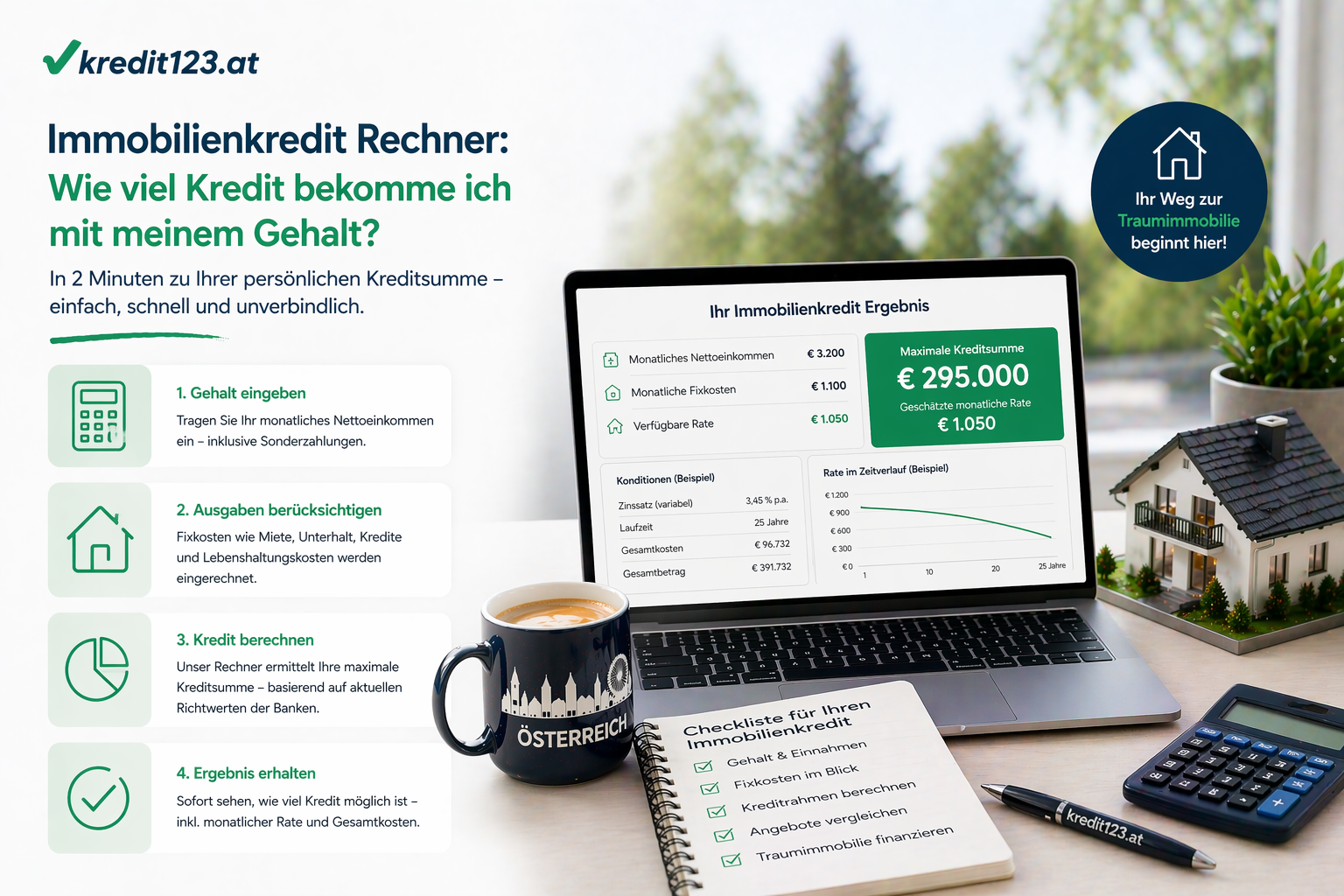
Mortgage Calculator Austria: How Much Can You Borrow Based on Your Salary?
Mortgage Calculator: How much mortgage can I get with my salary in Austria? "How much mortgage can I get with my salary?" — this is the first question almost everyone asks before even starting to look for a property. The answer depends on more than just your salary. This article explains the exact calculation, provides concrete tables for various income situations, and shows what you can do to increase your maximum loan amount when looking for a property loan Austria.
Read more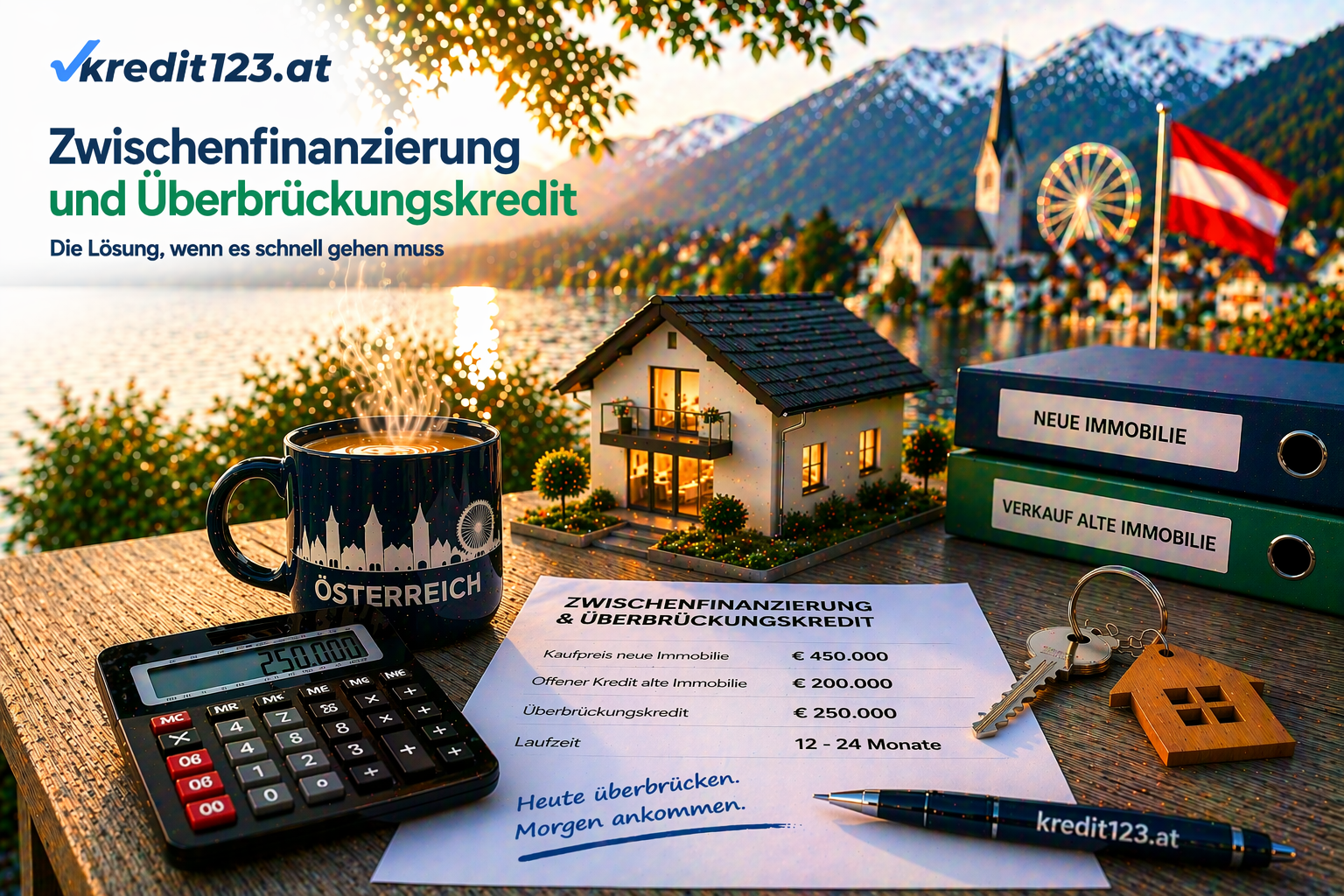
Bridging Loans for Property in Austria: Tips & Costs for Expats
Bridging finance for property purchase in Austria: When your new home arrives before your old one sells. You've found your dream apartment – but your current property isn't sold yet. This situation is common for many property buyers in Austria – and it has a name: bridging finance. This article explains how it works, what it costs, when it makes sense, and when it should be avoided for expats looking to buy property in Austria.
Read more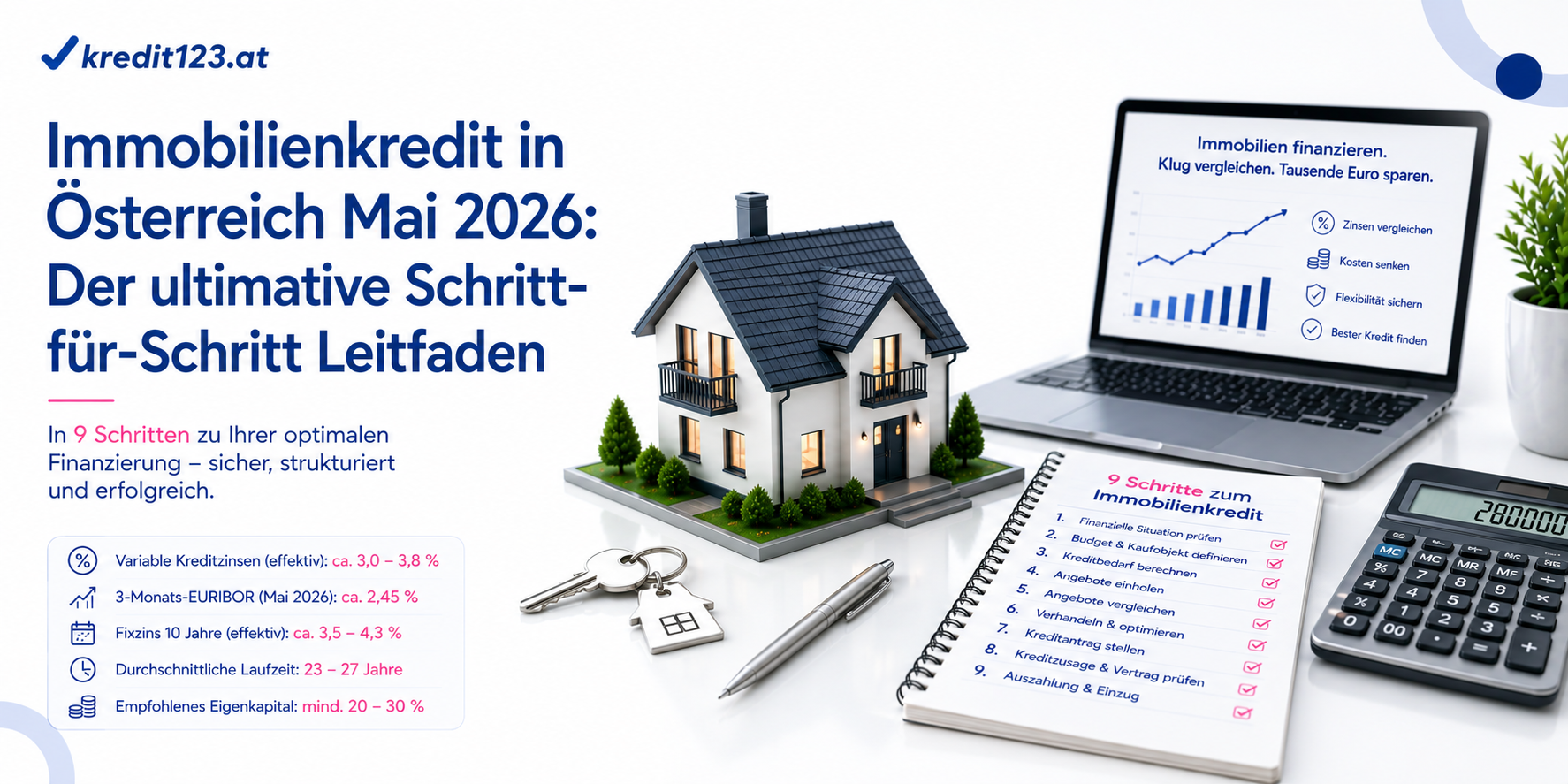
Immobilienkredit Österreich 2026: Leitfaden zur Finanzierung
Immobilienkredit in Österreich 2026: Der ultimative Schritt-für-Schritt LeitfadenDieser Leitfaden ist die wohl fast vollständige Antwort auf alle Frag...
Read moreQuestions about your financing?
Our experts advise you personally and find the optimal solution for your property financing in Austria.