
Property Loans for Pensioners in Austria: What's Possible – and What's Not
Property Loans for Pensioners in Austria: What's possible and what's not in retirement. Learn how to secure a mortgage in Austria as an expat, even in your golden years.
Property Loans for Pensioners in Austria: What's Possible – and What's Not
If you're a pensioner in Austria looking to buy property, renovate, or finance a home for the next generation, you'll encounter specific hurdles with Austrian banks – but these are not insurmountable. This article explains how banks assess pension income, what age limits apply, what alternatives exist, and how financing can still be achieved in retirement. Before you start, you should compare property loans to get a feel for current market interest rates.
Why This Topic Is More Important Than Ever in 2026
Austria's population is aging. The baby boomers of the 1950s and 1960s are now retired or nearing retirement. At the same time, many of these individuals are affluent – they have saved for decades, owned properties, and built up capital. And they have specific financing needs:
Buying an apartment because their current rental no longer suits their needs.
Renovating a house or making it barrier-free.
Co-financing a property for their children or grandchildren.
Acquiring a holiday home.
Or leveraging their own property to create liquidity.
These are all legitimate financing wishes – and all face the same fundamental problem with Austrian banks: age is a risk factor that complicates lending. This article will explain why this is the case, what it means, and how to navigate it when seeking a mortgage Austria.
How Banks Assess Age in Lending
The Core Problem from a Bank's Perspective
Banks grant loans based on two fundamental considerations: Can the borrower afford the repayments? And what happens if they can no longer pay? For pensioners, the first question is often unproblematic – a pension is a stable, state-guaranteed income.
The second problem is the real one: What happens if the borrower dies before the loan is repaid? In this case, the loan would pass to the heirs – or the bank would have to liquidate the property. Both are risks for the bank, which they weigh more heavily as the borrower's age increases, especially for an expat mortgage.
The Maximum Loan Age – The Most Important Limit
Most Austrian credit institutions have an internal limit: the loan must be fully repaid by a certain age. This limit, depending on the institution, is between 75 and 80 years – some institutions may extend it to 85 years in individual cases, while others strictly adhere to 75. This is a crucial factor when you want to buy property Austria.
This directly impacts the maximum possible term for your home loan:
Age at Loan Application | Max. Loan End 75 Yrs | Max. Loan End 80 Yrs | Maximum Term |
|---|---|---|---|
60 Years | 15 Years | 20 Years | 15–20 Years |
65 Years | 10 Years | 15 Years | 10–15 Years |
70 Years | 5 Years | 10 Years | 5–10 Years |
75 Years | Hardly Possible | 5 Years | 0–5 Years |
What this means for the monthly installment: With a shorter term, the installment increases significantly. A loan of 150,000 Euros at 3.5% interest over 10 years costs approximately 1,485 Euros monthly – over 20 years, it's only 870 Euros. So, someone buying at 70 years old must manage a significantly higher monthly burden than someone at 50. This is a key consideration for property loan Austria applicants.
How Pension Income is Calculated
This is where pensioners surprisingly fare well – if their pension is sufficiently high. The Austrian pension is a reliable, state-guaranteed income. It doesn't disappear during economic downturns, isn't cut due to company insolvency, and isn't seasonal. This makes it a strong asset for real estate financing Austria.
From a bank's perspective, a stable pension is excellent proof of income – more reliable than some employee salaries. What banks typically require:
Pension statement (Pensionsbescheid) or current pension slip (Pensionszettel)
Bank statements from the last three to six months, proving regular pension payments
For multiple pensions: all relevant documentation
For the affordability calculation, the same rule of thumb applies as for employees: the monthly loan installment should not exceed 35 to 40 percent of net income – meaning net pension. This is part of the KIM-Verordnung (Credit Institutions Real Estate Financing Measures Ordinance) guidelines.
What a Typical Pension Allows as Loan Security
For orientation: An average Austrian ASVG (general social insurance law) pension in 2026 is approximately 1,800 to 2,200 Euros net monthly. With a 35% debt service ratio, this results in an affordable installment of approximately 630 to 770 Euros. At an interest rate of 3.5% and a 10-year term, this corresponds to a loan volume of approximately 62,000 to 76,000 Euros. This is too little for many projects – but certainly sufficient for a renovation or a smaller conversion. When considering a mortgage Austria, this calculation is vital.
Those with an above-average pension – for example, former senior employees, civil servants, or self-employed individuals with good years – have correspondingly more leeway. To better plan your monthly fixed costs, you should calculate the ancillary costs in advance.
The Most Important Financing Scenarios for Pensioners
Scenario 1: Buying an Apartment in Retirement – Moving to Age-Appropriate Housing
The most common scenario: Older people want to move from a house (too large, too high-maintenance) to a smaller, barrier-free apartment. Or from a rental apartment to an owned property, because rent is rising and equity is available. In this case, sufficient equity from the sale of the previous house is often available. The loan is then only needed for the difference between the purchase price and available equity – and is accordingly manageable. This is a frequent reason for an expat mortgage.
Example: House sold for 450,000 Euros. New apartment costs 320,000 Euros plus 30,000 Euros ancillary costs. After deducting all costs, 400,000 Euros remain. No loan needed – or only a very small one for short-term bridging. If you are facing this decision, you can use our Rent or Buy? calculator.
Scenario 2: Renovation and Barrier-Free Conversion
Many pensioners already live in their own property and want to renovate it – making it barrier-free, energetically renovating, installing an elevator, modernizing the bathroom. There are two financing options for these projects:
Topping up an existing mortgage (Hypothekarkredit): If a loan is still running and there is sufficient collateral margin, the existing loan can be topped up. This is often the cheapest solution.
Independent renovation loan: A separate loan for renovation – with or without a land register (Grundbuch) security, depending on the volume. For smaller renovations up to approx. 50,000 Euros, a loan without a Grundbuch lien may be sufficient.
Important: For energetic renovation measures, there are federal and state subsidies in Austria that can significantly reduce financing costs. These must be applied for before construction begins. This can greatly reduce the cost of your property loan Austria.
Scenario 3: Financing for Children or Grandchildren – Generational Loan
Pensioners are increasingly involved as co-applicants, guarantors, or collateral providers for property loans for their children or grandchildren. This is a complex topic with several models:
Co-applicant: The pensioner takes out the loan together with the child. Both are jointly and severally liable.
Guarantor: The pensioner guarantees the child's loan. The liability risk is real.
Cross-collateralization: The pensioner's debt-free property is used as additional security.
Gift: The pensioner gifts equity to the child – without taking on loan liability themselves.
All these models have legal and tax implications that should be individually examined. Especially with guarantees and cross-collateralization: What happens in the event of inheritance? These are important considerations for real estate financing Austria.
Scenario 4: Leveraging Property – Liquidity from Existing Ownership
Some pensioners own a debt-free property and want to extract liquidity from it – for travel, care, or supporting their children. In Austria, it is generally possible to encumber the property with a mortgage for this purpose. This is called Immobilienbeleihung (property leveraging). The conditions are the same as for other mortgages – the age limit and term restrictions apply equally. This is a way to get a mortgage Austria even in retirement.
The Annuity (Leibrente): An Alternative to a Traditional Loan
The Leibrente (annuity or life annuity) is an instrument that is becoming increasingly relevant in Austria for older property owners – even if it is not a classic loan product.
How the Annuity Works
The property owner sells their property – but retains a lifelong right of residence (or usufruct). In return, they receive either a one-time payment, a monthly annuity, or both. This model is particularly interesting for older people who want to remain in their property but need liquidity. This can be an alternative to an expat mortgage.
Advantages of the Annuity | Disadvantages of the Annuity |
|---|---|
No loan risk, no installment burden | Ownership is lost |
Lifelong liquidity | Calculation based on life expectancy |
Right of residence remains | Legally very complex |
No age limit like with banks | Possible transfer below value |
What Improves Your Chances of Loan Approval in Retirement
Provide high equity: The higher the equity contribution, the smaller the loan – and the more manageable the monthly installment despite a short term. As a rule of thumb for pensioners: at least 30 to 40 percent equity is a good starting point for a property loan Austria.
Involve a younger co-applicant: If a spouse or child is significantly younger, a joint application can mitigate the age issue. The younger co-applicant effectively extends the bank's potential loan horizon.
Choose a short term with a high installment: Those with an above-average pension can consciously choose a short term. This sends a positive signal to banks.
Find the right bank: Not all Austrian banks have the same age limits. Some institutions go up to 80 years as the loan age, others stick to 75. It is crucial to specifically approach institutions that are open to your particular profile when seeking a mortgage Austria.
Typical Documents for Pensioners When Applying for a Loan
Document | Purpose | Note |
|---|---|---|
Current Pension Statement (Pensionsbescheid) | Proof of Income | Shows pension amount and type |
Pension Slips (last 3 months) | Prove current income | Similar to a payslip |
Bank Statements (3–6 months) | Payment behavior | Shows regular income |
KSV Extract | Creditworthiness | Check yourself beforehand |
Proof of Equity | Origin and amount | Bank statements, deposit statements |
Photo ID | Identity | — |
Purchase Agreement / Offer to Purchase | Proof of property | Prepared by a notary |
Frequent Questions from Pensioners About Property Financing
Can I still get a property loan at 70 years old? Generally yes – but with significant restrictions on the term. With an age limit of 80 years, a maximum of ten years remains. This means high monthly installments. Whether this is affordable for your specific project depends on the individual case. We are happy to check this without obligation. This is a common question for those looking to buy property Austria later in life.
Does an occupational pension count in addition to the ASVG pension? Yes – if it is permanent and documented. Occupational pensions, widow's pensions, and other regular retirement incomes can be counted as additional income for your expat mortgage.
Can I leverage my debt-free property to free up money for my children? Generally yes – through a mortgage. However, the age limit and term restrictions also apply here. Alternatively, a gift or a sale with a right of residence could be considered.
My spouse is significantly younger – does that help with the loan term? Yes – if the younger spouse is included as a co-applicant, this can extend the possible term because the bank considers the risk based on both life expectancies. This can be a smart strategy for real estate financing Austria.
What happens to the loan if I die? The loan passes to the heirs – along with the property. The heirs can either continue to service the loan or sell the property. If you already have a loan, you should regularly check for refinancing options to save on interest costs.
How kredit123.at Helps with Financing in Retirement
Pensioners are a target group to whom we at kredit123.at pay special attention – because the standard path to a house bank often ends in rejection, even though the economic starting position is actually solid. We know the institutions that are more flexible with age limits and fully account for occupational pensions when considering a mortgage Austria.
We thoroughly examine the profile – pension income, equity, property quality – and specifically select the institutions that are suitable for your particular project. If a traditional bank loan is not the right path, we will show you alternatives – renovation subsidies, generational models, or other structured solutions.
Non-binding initial consultation for pensioners and older borrowers – we check what is possible for your situation → kredit123.at (https://kredit123.at)
Checklist: Preparation for Pensioners
Collected all income statements: ASVG pension, occupational pension, widow's pension
Fully recorded equity and documented its origin
Requested and checked KSV (credit bureau) extract yourself in advance
Calculated a realistic term based on your age for your property loan Austria
Checked affordability: Is the installment affordable monthly with a short term?
Considered co-applicants: Is there a younger partner or child?
Considered alternative models: renovation subsidies, generational loans, annuities
Clarified legal questions regarding guarantees or cross-collateralization in advance
Planned a targeted institutional comparison – not random inquiries
We are happy to guide you through the entire process and prepare your loan application: Arrange a consultation appointment

Conclusion: Financing is Possible in Retirement – With the Right Strategy
Retirement is not an automatic disqualifier for a property loan. It is a restriction on the term – and thus on the monthly installment. Those with a solid pension, sufficient equity, and who find the right institution can still finance a property even at 65 or 70 years old. The key lies in a realistic assessment of your own situation and targeted access to suitable institutions when you want to buy property Austria.
If you want to finance in retirement, you should not do it alone – but with an advisor who knows the market and where the opportunities lie. Use our expertise for your success.
Plan your future in your own home now: Let our experts support you and find the optimal financing solution for your age. Request a non-binding consultation now and benefit from top conditions!
This article is for general information purposes only and does not constitute individual financial, legal, or tax advice. All information regarding bank guidelines and age limits are general market observations without guarantee and may vary depending on the institution and individual situation. For specific questions about annuities, inheritance law, and tax aspects, we recommend consulting an Austrian lawyer or notary.
Useful Tools for Your Financing
Related Articles
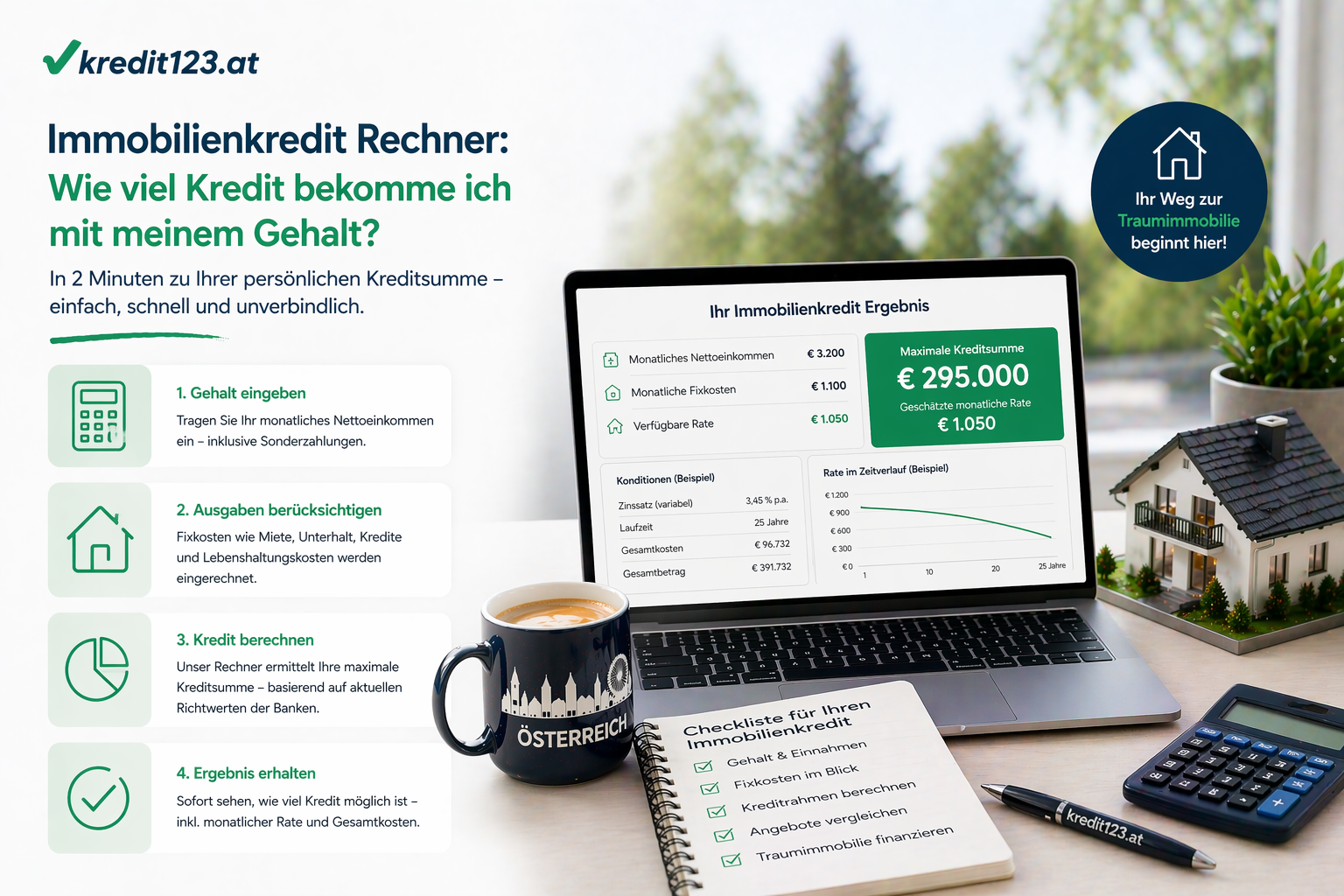
Mortgage Calculator Austria: How Much Can You Borrow Based on Your Salary?
Mortgage Calculator: How much mortgage can I get with my salary in Austria? "How much mortgage can I get with my salary?" — this is the first question almost everyone asks before even starting to look for a property. The answer depends on more than just your salary. This article explains the exact calculation, provides concrete tables for various income situations, and shows what you can do to increase your maximum loan amount when looking for a property loan Austria.
Read more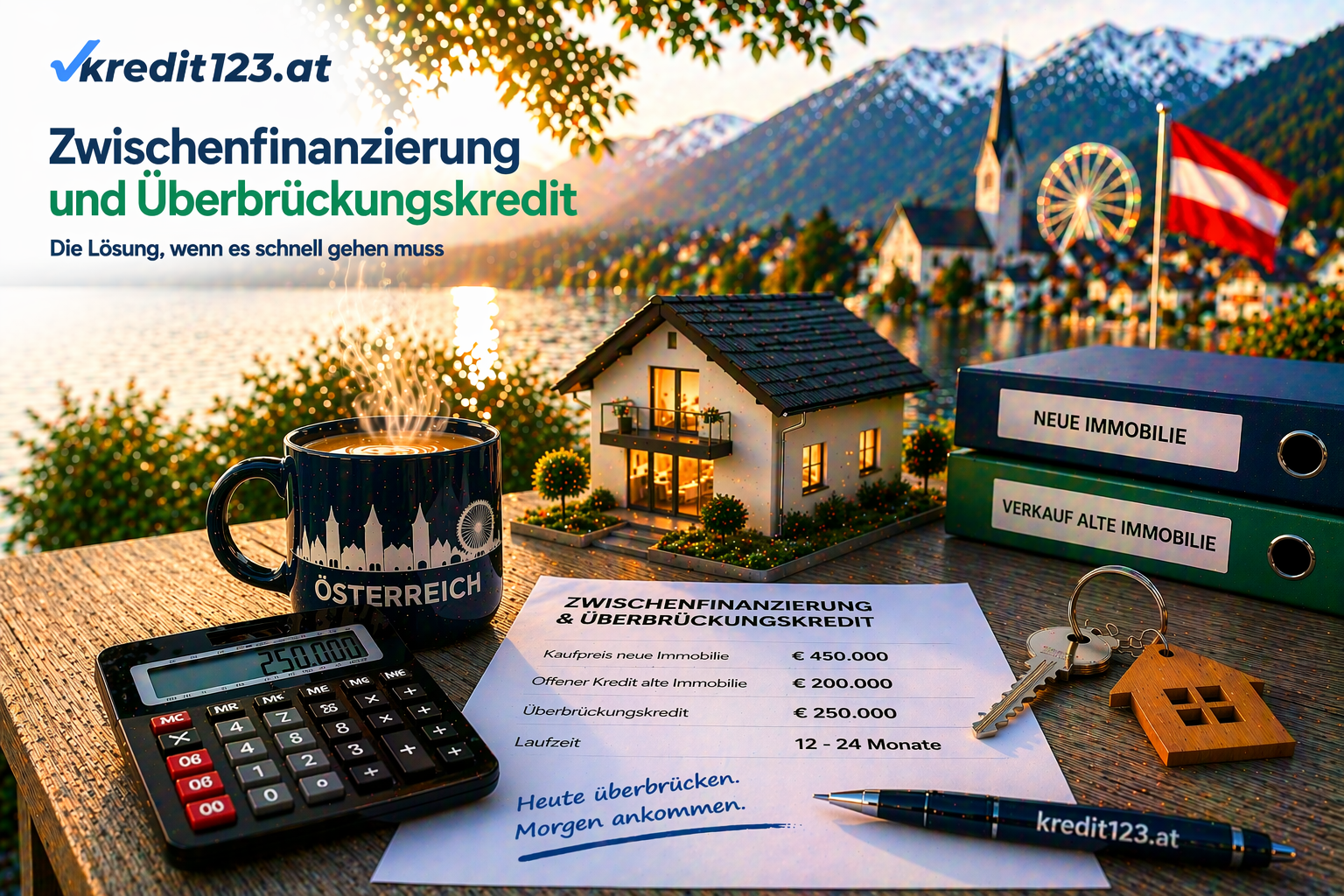
Bridging Loans for Property in Austria: Tips & Costs for Expats
Bridging finance for property purchase in Austria: When your new home arrives before your old one sells. You've found your dream apartment – but your current property isn't sold yet. This situation is common for many property buyers in Austria – and it has a name: bridging finance. This article explains how it works, what it costs, when it makes sense, and when it should be avoided for expats looking to buy property in Austria.
Read more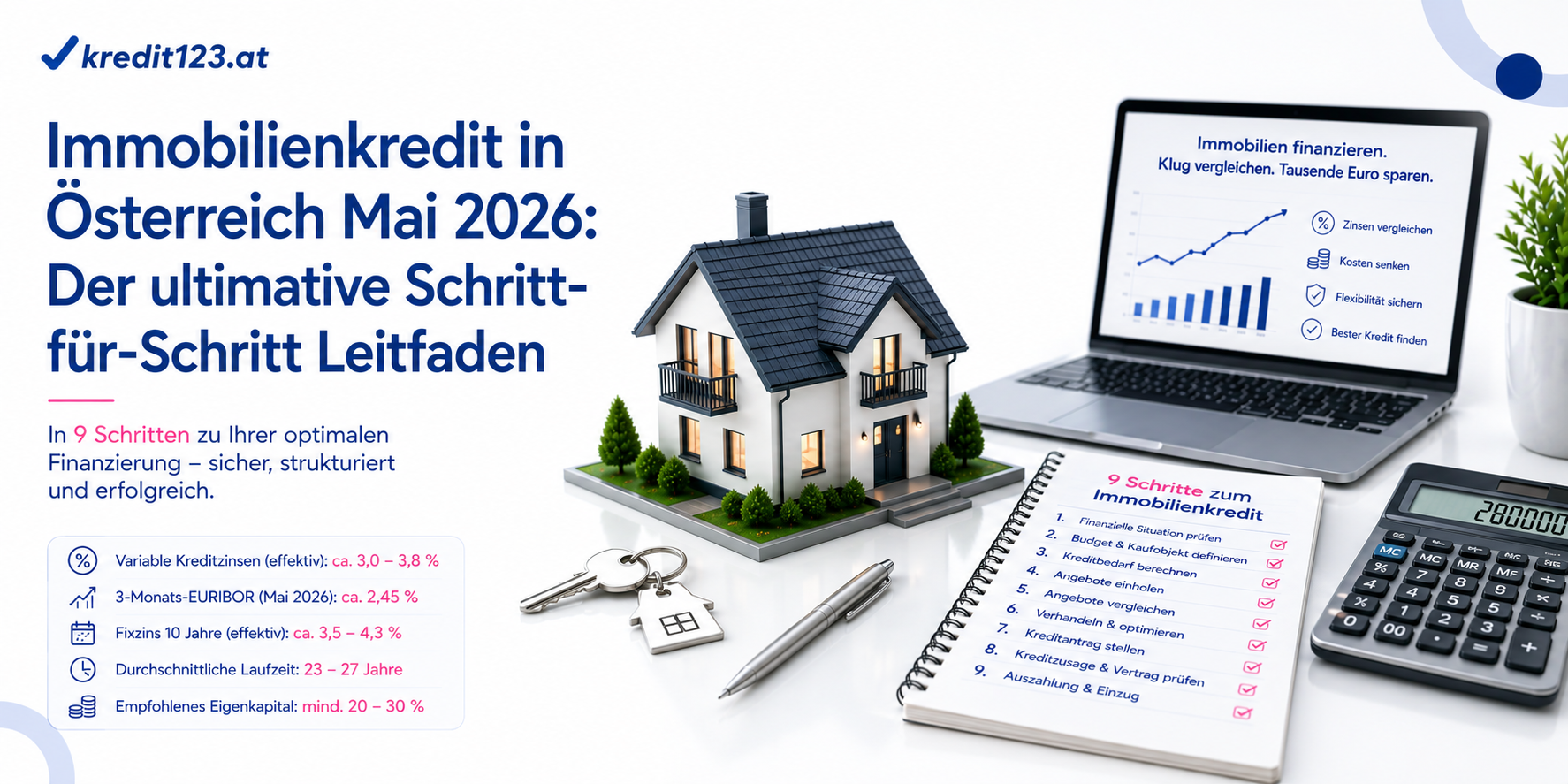
Immobilienkredit Österreich 2026: Leitfaden zur Finanzierung
Immobilienkredit in Österreich 2026: Der ultimative Schritt-für-Schritt LeitfadenDieser Leitfaden ist die wohl fast vollständige Antwort auf alle Frag...
Read moreQuestions about your financing?
Our experts advise you personally and find the optimal solution for your property financing in Austria.