
Real Estate in Austria: Buying, Building, or Renovating? The 2026 Guide
Buying an apartment, building a house, or renovating in Austria? Discover the best property loan Austria options and financing tips for expats in 2026.

Real Estate in Austria: Buying, Building, Renovating, or Renting – Which fits your situation?
Buying a condominium, building a house, finishing a semi-completed property, or renovating an existing apartment – the paths to owning a home in Austria are diverse. Which option suits your life stage, what are the respective pros and cons, and how does real estate financing Austria work in each case? Read this guide to find out.
Overview: Comparing the Key Options
Before committing, it is worth taking an objective look at all the possibilities. In Austria, you generally have the following paths to your own home:
Option | Typical Timeline | Equity Requirement | Planning Effort | Flexibility |
|---|---|---|---|---|
Buy Apartment (Existing) | 3–6 Months | Medium (20–30%) | Low | Medium |
Buy New Build (Developer) | 1–3 Years | Medium–High | Low–Medium | Low |
Buy House (Existing) | 3–9 Months | Medium–High | Low | Medium |
Build New House (Plot + Construction) | 2–4 Years | High (25–35%) | Very High | High |
Finish Semi-completed Property | 1–3 Years | Medium–High | High | Medium |
Renovate Existing Property | 6–18 Months | Low–Medium | Medium | High |
Attic Conversion | 1–2 Years | Medium | High | Medium |
Rent (for comparison) | Immediate | Low | Low | Very High |
Option 1: Buying a Condominium
The most common choice to buy property Austria – especially in Vienna, Graz, and Salzburg, where the supply of single-family houses in urban locations is limited.
Advantages of an Existing Apartment
Fastest way to ownership – move-in is often possible within a few months.
Manageable closing costs compared to building a house. Use our Closing Cost Calculator for details.
No construction project risk; no site manager or architect required.
Location, infrastructure, and condition are already known at the time of purchase.
Ideal for professionals without the time for a construction project.
Disadvantages
Less design freedom than with a new build.
Maintenance obligations and collective decisions within the homeowners' association (WEG - Wohnungseigentumsgesetz).
Condition of building services, pipes, and the roof is not always transparent.
In popular locations, existing apartments remain expensive in 2026, even after the price corrections of 2023/24.
What to Look For When Buying
Before buying, it is essential to: check the Grundbuch (Land Registry) for encumbrances, liens, or easements; read the apartment ownership contract; review minutes of recent owners' meetings; and have the condition of heating, electrics, and windows assessed.
A structural condition report by an independent expert costs a few hundred euros but can prevent thousands of euros in surprise costs.
Financing a Condominium
An existing apartment is the most straightforward object for an expat mortgage. The bank evaluates the property as collateral, the transaction is handled by a notary or lawyer, and the loan agreement can often be finalized within a few weeks.
Typical financing structure: 20–30% equity, 70–80% bank loan, term of 20–30 years. With good credit and sufficient equity, effective interest rates from approx. 3.5% are realistic in 2026 – depending on the term, fixed-rate model, and individual profile.
Use our Mortgage Calculator to quickly calculate your monthly rate for various scenarios.
Option 2: Buying a New Build from a Developer
Those who want modern living without building themselves often choose a new build from a developer (Bauträger). In Vienna, new projects are constantly emerging – from Seestadt Aspern to the Sonnwendviertel.
Advantages
Latest energy standards, modern building technology, often including photovoltaics and heat pumps.
Buyers can often customize finishes (floors, tiles, kitchen).
No hidden defects like in older properties.
Often includes underground parking and planned outdoor areas.
Long-term energy costs are lower than in old buildings (Altbau).
Disadvantages
Long waiting times – often 1.5 to 3 years between contract and move-in.
Construction cost risk formally lies with the developer, but insolvencies do happen – the BTVG (Developer Contract Act) protects you if applied correctly.
Installment payments based on construction progress: Financing must be coordinated with tranche payouts.
Location and surroundings cannot be fully assessed at the time of purchase.
Defects after handover occur more frequently than with existing properties.
Legal Specifics: BTVG
When buying a new build, the Bauträgervertragsgesetz (BTVG) applies. It mandates that buyer payments must be secured by bank guarantees, ownership priority notices, or escrow accounts. Reputable developers comply with this – for cheap offers from unknown providers, you should have this explicitly checked in the contract.
Financing for Developer Purchases
The unique feature of new build projects is installment financing based on construction progress. The bank does not pay out the loan all at once, but in tranches. During this time, the buyer often only pays interest on the amount already disbursed – the full installment begins only after completion.
This means: During the construction phase, you may have to pay rent (old apartment) and mortgage interest (new apartment) simultaneously. This must be factored into your household budget.
Option 3: Buying a Single-Family House (Existing)
Buying an existing house is a realistic option in Austria, especially in the commuter belts (Speckgürtel) of cities and rural areas. Prices corrected significantly in 2023/24.
Advantages
Immediately habitable (after any necessary renovations).
Garden, garage, more space than an apartment.
Often lower price per square meter than in city centers.
More privacy than in a homeowners' association.
No collective decisions, no property management fees.
Disadvantages
The owner bears all maintenance costs alone (roof, heating, facade).
Building services in older houses often need renewal.
Poorer energy efficiency than new builds – renovation needs are often underestimated.
Commuting distance to city centers can be significant.
Older houses can have hidden defects (moisture, asbestos, outdated electrics).
What to Watch For When Buying a House
For a house, an assessment by a building expert is even more important than for an apartment. The roof, cellar, heating system, electrics, and windows should be evaluated technically. An outdated oil heating system that needs replacement soon can cost 15,000 to 30,000 euros.
Also check: Zoning plans (Widmung) and building regulations (what else can be built on the plot?), existing servitudes and rights of way, sewer connection, and wastewater disposal.
Financing
Banks generally like to provide a mortgage Austria for existing houses – the property is well-valued as collateral, especially in sought-after locations. Renovation costs can often be included in the property loan Austria if documented in the purchase contract or an expert report.
Option 4: Building Your Own House – Plot and New Construction
Building yourself means maximum design freedom – and maximum effort. It is the option that requires the most time, energy, and equity, but allows for the most individual solution.
Advantages
Complete freedom in floor plan, equipment, and architecture.
Modern energy standards planned from the start (passive house, low energy).
No renovation backlog, no hidden defects.
Lowest long-term operating costs with good planning.
Individual adaptation to family size and life stages.
Disadvantages
Longest path to homeownership: Plot search, planning phase, permits, construction time – realistically 3 to 5 years.
Highest planning and coordination effort: Architect, structural engineer, construction companies, authorities.
Cost escalation risk: Construction projects almost regularly exceed the budget – a 10 to 20% buffer is not uncommon.
Construction prices remain high after the sharp rise in 2021–2023.
Plot prices in suburban areas are still at a high level despite slight corrections in 2024.
The Construction Process in Austria – Overview
Plot Search and Zoning Check: Not every plot is buildable. The zoning (Widmung) and building plan decide.
Architectural Planning and Submission: Building permits take 3 to 12 months depending on the municipality.
Tendering and Awarding: Trades are awarded individually or to a general contractor.
Construction Phase: Shell, roof, building services, interior finishing.
Completion and Commissioning: Inspection by the building authority and occupancy permit (Benützungsbewilligung).
Financing for House Construction
Construction financing is more complex than a standard mortgage. The bank pays out the loan in construction tranches based on progress. Typical milestones: Shell, roof, windows, interior, completion.
Important: Before loan approval, the bank requires the building permit, submission plans, a cost estimate, and the plot purchase or lease agreement. For professional guidance, you can request a consultation at any time.
Option 5: Finishing a Semi-completed Property – The "Divorce House"
This option is more common in practice than one might think – and it has an unofficial name: the divorce house. The situation: A couple started building a house together, then separated. The project stalls, financing is unclear, one side wants to sell, the other wants to keep building.
Advantages
Often significantly cheaper than comparable finished properties.
Basic structure already exists – shell, foundation, often the roof.
Buyer can fully determine the interior design.
Good negotiating position as the seller is often under pressure.
Potential for significant value increase after completion.
Disadvantages
High planning and coordination effort for completion.
Existing construction defects or moisture damage possible due to the interruption.
Building permit must be checked – is it still valid?
Unclear ownership situations in divorce cases.
Financing costs for the purchase plus completion costs must be calculated together.
Legal Specifics of Divorce Houses
This is the most sensitive point. If the property is still jointly owned by both ex-partners, you need the consent of both for the purchase. Before buying a semi-completed divorce property, a Grundbuch extract and a legal review by an Austrian lawyer are absolutely necessary.
Realistically Estimating Completion Costs
Trade | Approx. Cost Range | Depends on |
|---|---|---|
Heating / Heat Pump | 15,000 – 35,000 EUR | System, building size |
Electrical Installation | 8,000 – 20,000 EUR | Standard, area |
Sanitary / Bathroom | 10,000 – 30,000 EUR | Number of baths, fittings |
Windows and Doors | 15,000 – 40,000 EUR | Number, material, glazing |
Interior Plaster and Screed | 8,000 – 20,000 EUR | Area |
Flooring | 6,000 – 20,000 EUR | Material, area |
Outdoor / Garage | 10,000 – 30,000 EUR | Scope |
Total (Rough Guide) | 70,000 – 200,000 EUR | Depending on stage |
All figures are rough guidelines without guarantee. A cost estimate by a building expert before purchase is strongly recommended.
Option 6: Renovating or Refurbishing an Existing Property
Those who are already owners – or buy a cheap, renovation-needy property – can create significant value through targeted refurbishment. In Austria, there are also state subsidies available for this.
Advantages
Often lower entry price due to renovation discount.
Value creation through personal labor possible.
State renovation subsidies (Wohnbauförderung, federal thermal renovation subsidies).
Long-term energy costs can be significantly reduced.
Disadvantages
Residents often have to move out during renovation.
Renovation costs are frequently underestimated.
Coordinating tradespeople is time-consuming.
Renovation Subsidies in Austria 2025
The subsidy landscape is complex. The following programs are relevant in 2025:
Federal Thermal Renovation Subsidy: Supports insulation, window replacement, and heating system conversion.
State Housing Subsidies (Wohnbauförderung): Each federal state has its own programs with low-interest loans or grants.
Tax Deductibility: Maintenance costs for rental properties are tax-deductible.
Renting vs. Buying – When is it the Better Choice?
Renting is superior if you plan to move within the next three to five years or if your equity is not yet sufficient. Use our Rent-vs-Buy Calculator for a sound decision.
In Vienna, the price-to-rent ratio has improved to approx. 25–30 years after the price corrections of 2023/24, making buying more attractive in many locations again.
Mortgage Comparison: What Matters for Every Option
Regardless of which path you choose – these factors are always relevant for real estate financing Austria:
Equity Ratio: The KIM-Verordnung (Kreditinstitute-Immobilienfinanzierungs-Risikobegrenzungsverordnung) requires at least 20%.
Affordability: The monthly loan installment should be a maximum of 40% of net income.
Loan Term: The optimal term depends on age and income.
Fixed vs. Variable: Fixed rates offer planning security, especially for new builds.
Prepayment Rights: Always secure these contractually for maximum flexibility.
Conclusion: No Option is Universally Better
The right decision depends on your life situation: Where are you professionally and family-wise? How much time can you invest? What is your risk tolerance?
Little time, move in fast: Buy an existing apartment
Modern, energy-efficient: New build from a developer
Space, garden, suburban: Buy an existing house
Maximum individuality: Build your own house
Low entry price: Semi-completed property or renovation
Whatever you choose: The financing should fit the option – not the other way around. An independent mortgage broker can help you bring both together.
Secure Your Property Financing in Austria Now!
Are you planning to buy, build, or renovate a property? Get independent advice from our experts and find the best property loan Austria on the market.
Useful Tools for Your Financing
Related Articles
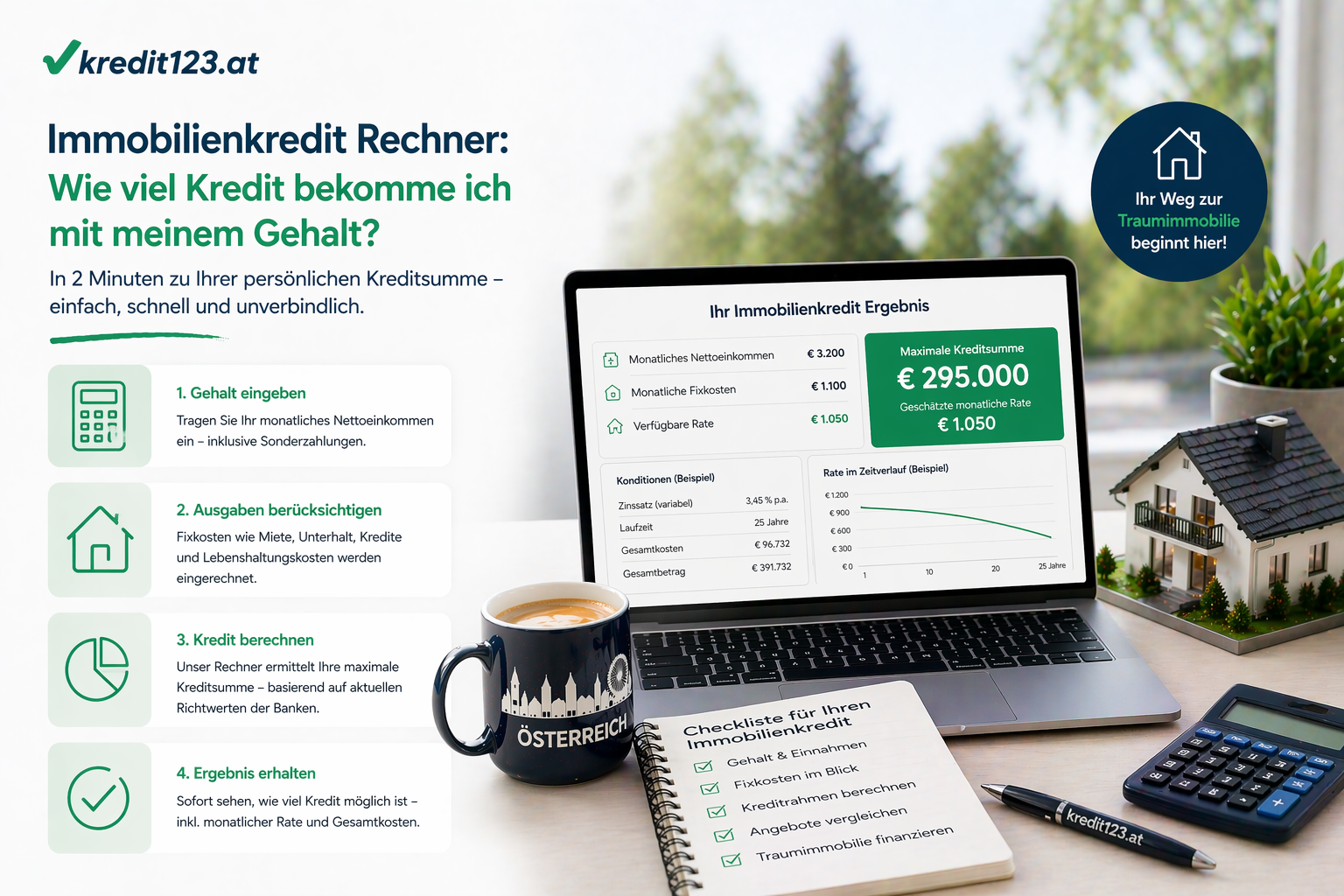
Mortgage Calculator Austria: How Much Can You Borrow Based on Your Salary?
Mortgage Calculator: How much mortgage can I get with my salary in Austria? "How much mortgage can I get with my salary?" — this is the first question almost everyone asks before even starting to look for a property. The answer depends on more than just your salary. This article explains the exact calculation, provides concrete tables for various income situations, and shows what you can do to increase your maximum loan amount when looking for a property loan Austria.
Read more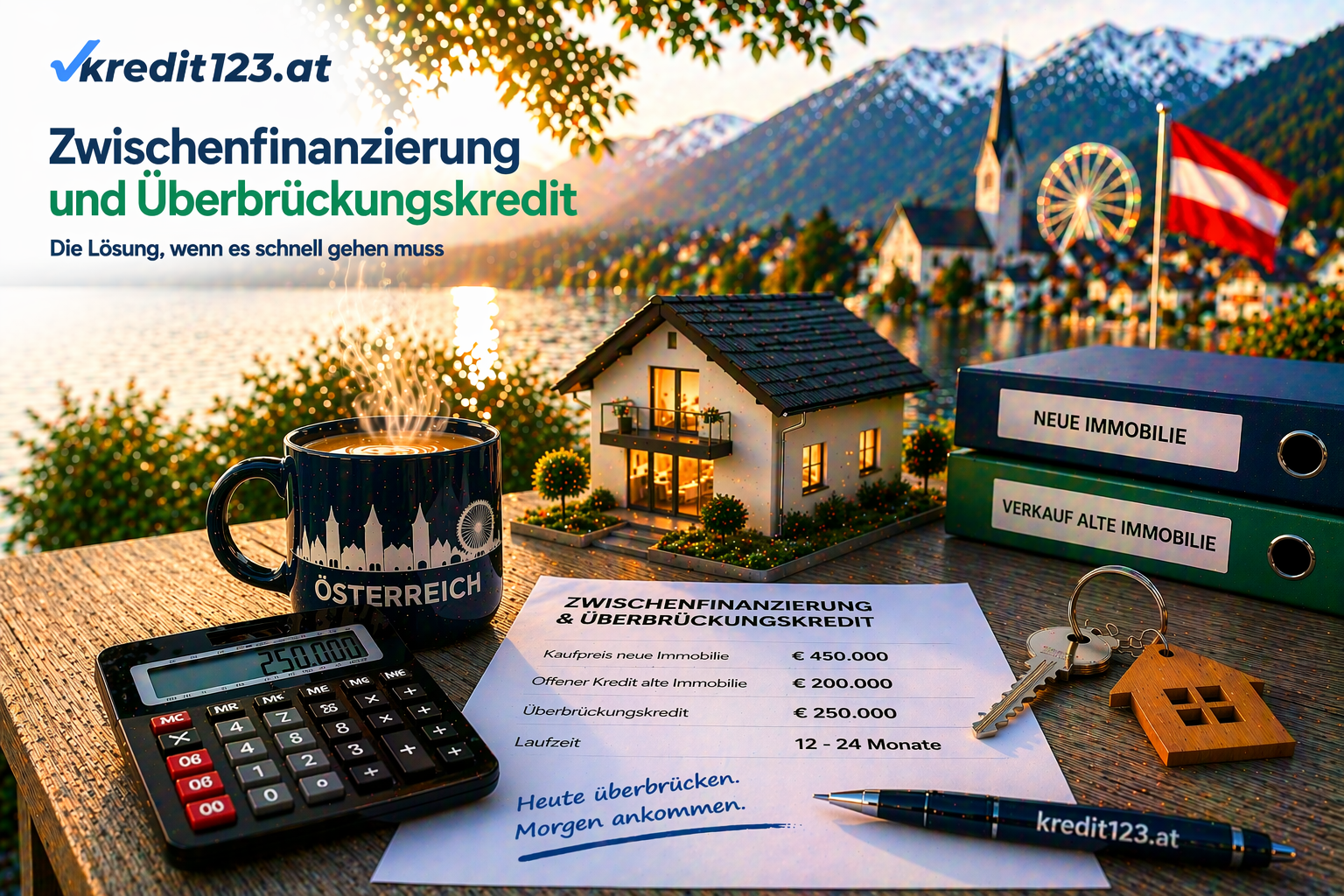
Bridging Loans for Property in Austria: Tips & Costs for Expats
Bridging finance for property purchase in Austria: When your new home arrives before your old one sells. You've found your dream apartment – but your current property isn't sold yet. This situation is common for many property buyers in Austria – and it has a name: bridging finance. This article explains how it works, what it costs, when it makes sense, and when it should be avoided for expats looking to buy property in Austria.
Read more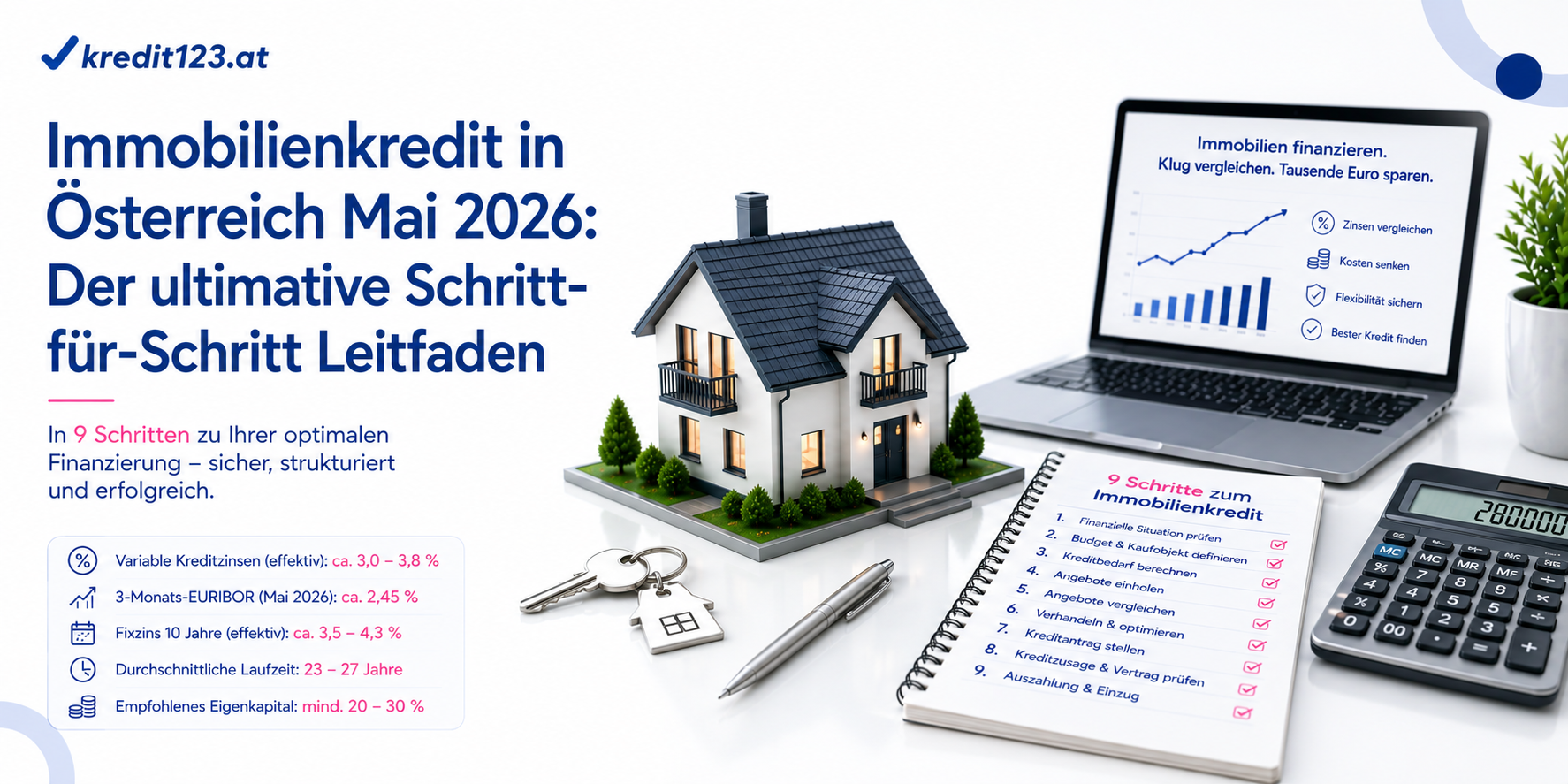
Immobilienkredit Österreich 2026: Leitfaden zur Finanzierung
Immobilienkredit in Österreich 2026: Der ultimative Schritt-für-Schritt LeitfadenDieser Leitfaden ist die wohl fast vollständige Antwort auf alle Frag...
Read moreQuestions about your financing?
Our experts advise you personally and find the optimal solution for your property financing in Austria.