
Calculating Your Home Loan in Austria 2026: Costs & Interest Rates for Expats
Calculating your home loan in Austria: What building a house really costs in 2026 – and how much mortgage you need. For expats looking to buy property in Austria, understanding the true costs is crucial. This article covers current construction costs, land prices, ancillary expenses, and how to determine your required mortgage amount and monthly repayments, optimized for 'mortgage Austria' and 'expat mortgage' keywords.
Calculating Your Home Loan in Austria: What Building a House Really Costs in 2026 – and How Much Mortgage You Need
If you're looking to calculate your mortgage Austria, the first thing you need is a reliable figure: what does the house actually cost? This is where many plans fail – not at the bank, but due to an unrealistic cost estimate. This article provides current construction costs, real land prices, all ancillary costs, and explains how to derive the required loan amount and monthly repayment from these figures, especially for expats looking to buy property Austria.
Why Most Home Loan Calculations Are Wrong from the Start
The most common mistake in planning an expat mortgage isn't choosing the wrong bank – it's starting with the wrong initial figures. If you plan with too low a total budget, you'll either build a smaller house than intended, run into refinancing problems during the construction phase, or exhaust your credit limit, leaving no financial buffer.
The reality of building a house in Austria in 2026: A turnkey single-family home with 130 square meters of living space, including land, construction, ancillary costs, and landscaping, will cost between 500,000 and 800,000 Euros in most regions. Planning with 350,000 Euros is simply unrealistic.
This doesn't mean that home construction isn't financeable. It means that an honest calculation is the first step – before approaching a bank or wanting to compare property loans.
Step 1: Land Costs – The Biggest Regional Difference
Land is often the most expensive single item when building a house – and also the one with the largest regional differences. While you can still find building plots for under 100 Euros per square meter in rural regions of Styria or Burgenland, comparable areas in the Vienna commuter belt cost five to ten times as much.
Current Indicative Values for Building Plots in Austria 2026:
Region | Price Range €/m² Building Land | Typical Plot Size | Total Land Costs |
|---|---|---|---|
Vienna (Outskirts) | 400 – 900 € | 300 – 500 m² | 150,000 – 450,000 € |
Vienna Commuter Belt (Lower Austria, nearby) | 200 – 500 € | 500 – 800 m² | 120,000 – 400,000 € |
Lower Austria (rural) | 50 – 200 € | 600 – 1,000 m² | 40,000 – 200,000 € |
Graz and Surroundings | 150 – 400 € | 400 – 700 m² | 80,000 – 280,000 € |
Styria (rural) | 30 – 120 € | 600 – 1,200 m² | 25,000 – 120,000 € |
Salzburg City and Surroundings | 300 – 700 € | 400 – 700 m² | 150,000 – 500,000 € |
Innsbruck and Surroundings | 400 – 900 € | 300 – 600 m² | 150,000 – 540,000 € |
Linz and Surroundings | 100 – 300 € | 500 – 800 m² | 60,000 – 240,000 € |
Burgenland | 30 – 100 € | 700 – 1,200 m² | 25,000 – 100,000 € |
Vorarlberg | 300 – 800 € | 300 – 600 m² | 120,000 – 480,000 € |
All prices are indicative values without guarantee. Actual prices depend on location, development status, zoning, and market conditions. As of: 2026.
What is Often Overlooked with Land Purchase
The purchase price is not the only cost factor when acquiring land. Additionally, the following apply:
Real Estate Transfer Tax (Grunderwerbsteuer): 3.5% of the purchase price.
Land Register Entry Fee (Grundbucheintragung): 1.1% of the purchase price. This registers your ownership in the official land registry, the Grundbuch.
Real Estate Agent Commission (Maklercourtage): Up to 3% plus VAT – if an agent is involved.
Notary or Lawyer Fees (Notar- oder Rechtsanwaltskosten): Approx. 1.0 to 1.5% of the purchase price.
Development Costs (Erschließungskosten): If the plot is not yet connected to sewage, water, electricity, and gas – depending on the effort, an additional 5,000 to 30,000 Euros.
Surveying Costs (Vermessungskosten): For unclear property boundaries or subdivisions – 1,000 to 5,000 Euros.
The ancillary costs for land acquisition thus amount to around 7 to 10% of the purchase price – in addition to the actual land price. Use our ancillary costs calculator to determine these amounts precisely.
Step 2: Construction Costs – What a House in Austria Costs in 2026
Construction costs are the largest cost block after the land – and the most frequently underestimated. After the sharp increase in construction costs from 2021 to 2023, prices stabilized in 2024 and 2025 but remained at the elevated level. A return to 2019 or 2020 prices is not expected.
Construction Costs by Building Method
Building Method | Cost per m² Living Space (net) | Characteristics |
|---|---|---|
Solid Construction (brick, concrete) | 2,200 – 3,200 € | Classic, high value retention, longer construction time |
Timber Frame Construction | 2,000 – 3,000 € | Faster construction, good insulation values, modern |
Prefabricated House (turnkey finish) | 1,800 – 2,800 € | Short construction time, defined costs, less individual |
Prefabricated House (shell-plus finish) | 1,400 – 2,200 € | Lower entry cost, DIY for flooring, painting |
Individual Construction with Architect | 2,800 – 4,500 € | Maximum design freedom, highest costs |
Net square meter prices excluding VAT. Living space refers to the finished, habitable area – not the gross area including walls and technical rooms.
What is Usually Not Included in the Construction Price
This is where budgets are regularly exceeded. Most offers from developers and prefabricated house manufacturers do not include:
Basement or Underground Garage: 30,000 to 80,000 Euros extra – depending on size and design.
Slab Foundation: For houses without a basement, 15,000 to 35,000 Euros.
Outdoor Facilities: Fencing, driveway, terrace, planting – 15,000 to 50,000 Euros.
Kitchen: 8,000 to 25,000 Euros – depending on equipment.
Heating and Heat Pump: 15,000 to 35,000 Euros – if not included in the base price.
Photovoltaic System: 10,000 to 25,000 Euros.
Architect's Fees: 8 to 15% of the construction sum for individual planning.
Construction Management and Supervision: 3 to 5% of the construction sum.
Utility Connection Costs (Hausanschlusskosten): Electricity, gas, water, sewage – 5,000 to 15,000 Euros.
Furnishings: Furniture, curtains, lighting – highly individual, but realistically 15,000 to 40,000 Euros.
Example Calculation: What a Single-Family House Really Costs in 2026
Assumption: Single-family house, 130 m² living space, solid construction turnkey, plot in Lower Austria commuter belt 600 m²:
Cost Item | Amount |
|---|---|
Land (600 m² × 300 €/m²) | 180,000 € |
Land Ancillary Costs (approx. 8%) | 14,400 € |
Shell and Fit-out (130 m² × 2,700 €) | 351,000 € |
Basement / Slab Foundation | 40,000 € |
Heating / Heat Pump | 25,000 € |
Outdoor Facilities / Terrace / Driveway | 25,000 € |
Kitchen | 12,000 € |
Architect and Planning Costs | 25,000 € |
Utility Connections | 8,000 € |
Furnishings (basic) | 20,000 € |
Buffer 15% on Construction Costs | 52,000 € |
Total Costs | approx. 752,000 € |
This is not a pessimistic estimate – it is a realistic calculation for a solid house in a sought-after commuter belt location. If you plan with 400,000 Euros, you will either build in a cheaper region, choose a smaller living area, or accept significant compromises in equipment. Before you decide, you should clarify the question of renting or buying for yourself.
Step 3: The Cost Buffer – Why 15 to 20% is Mandatory
House projects almost always exceed the original budget. This is not an exception – it is the rule. The reasons are diverse: unforeseen ground conditions, price increases for trades during the construction phase, planning changes, additional wishes, or defects that need to be rectified.
A buffer of 15% on the construction sum is not a precaution for pessimists – it is the minimum requirement for a serious calculation. For complex projects or uncertain ground conditions, it should be 20%.
Those who do not plan for a buffer risk needing additional financing in the middle of construction – possibly under worse conditions, under time pressure, and with a bank that is more critical precisely when you are most dependent on them. In such cases, it may be advisable to consider a loan refinancing.
Step 4: Calculating Equity – What Counts and What Doesn't
Since the expiration of the KIM-Verordnung (Credit Institutions Mortgage Ordinance) on 30 June 2025, there is no longer a statutory minimum equity ratio. Banks can individually decide how much equity they require. In practice, most institutions still demand between 15 and 25% of the total costs – not because they have to, but because it is prudent lending practice for real estate financing Austria.
Eligible as equity are:
Savings accounts, call money, fixed deposits
Building society savings contracts (Bausparverträge) and building society loans (Bauspardarlehen)
Securities accounts (with a discount depending on composition)
Surrender value of life insurance policies
Documented gifts from family members
Own contributions to construction – under certain conditions at some institutions
Provincial housing subsidies (Wohnbauförderungsdarlehen) as supplementary financing
Important: Your equity must cover the land ancillary costs and construction ancillary costs – banks generally do not finance these. As a rule of thumb: equity should cover at least all ancillary costs plus 10 to 15% of the total costs.
Step 5: Calculating Your Home Loan – The Key Parameters
Once you know the total costs and your available equity, you can derive the required loan amount for your property loan Austria:
Required Loan = Total Costs − Equity
From the loan amount, the monthly repayment results – depending on the interest rate and term. Here's an overview of the most important parameters:
Interest Rate 2026
After the end of the high-interest phase and several ECB interest rate cuts, effective interest rates for real estate loans in Austria in 2026 are between approx. 3.0 and 4.5%, depending on the model. Variable loans often start cheaper than fixed ones – but with corresponding interest rate risk.
Loan Term
The usual term for home loans in Austria is between 20 and 35 years. Longer terms reduce the monthly repayment but significantly increase the total interest costs.
Example Calculations for Monthly Repayment
Basis: 500,000 Euro Loan (after equity):
Interest Rate | Term 20 Years | Term 25 Years | Term 30 Years |
|---|---|---|---|
3.0 % | 2,773 € | 2,372 € | 2,108 € |
3.5 % | 2,900 € | 2,503 € | 2,245 € |
4.0 % | 3,030 € | 2,639 € | 2,387 € |
4.5 % | 3,163 € | 2,779 € | 2,534 € |
Example calculations for orientation only, without guarantee. Actual conditions depend on individual profile and the respective institution.
Basis: 350,000 Euro Loan:
Interest Rate | Term 20 Years | Term 25 Years | Term 30 Years |
|---|---|---|---|
3.0 % | 1,941 € | 1,660 € | 1,476 € |
3.5 % | 2,030 € | 1,752 € | 1,572 € |
4.0 % | 2,121 € | 1,847 € | 1,671 € |
4.5 % | 2,214 € | 1,945 € | 1,774 € |
Example calculations for orientation only, without guarantee.
For your specific situation: Use the loan calculator on kredit123.at (
Useful Tools for Your Financing
Related Articles
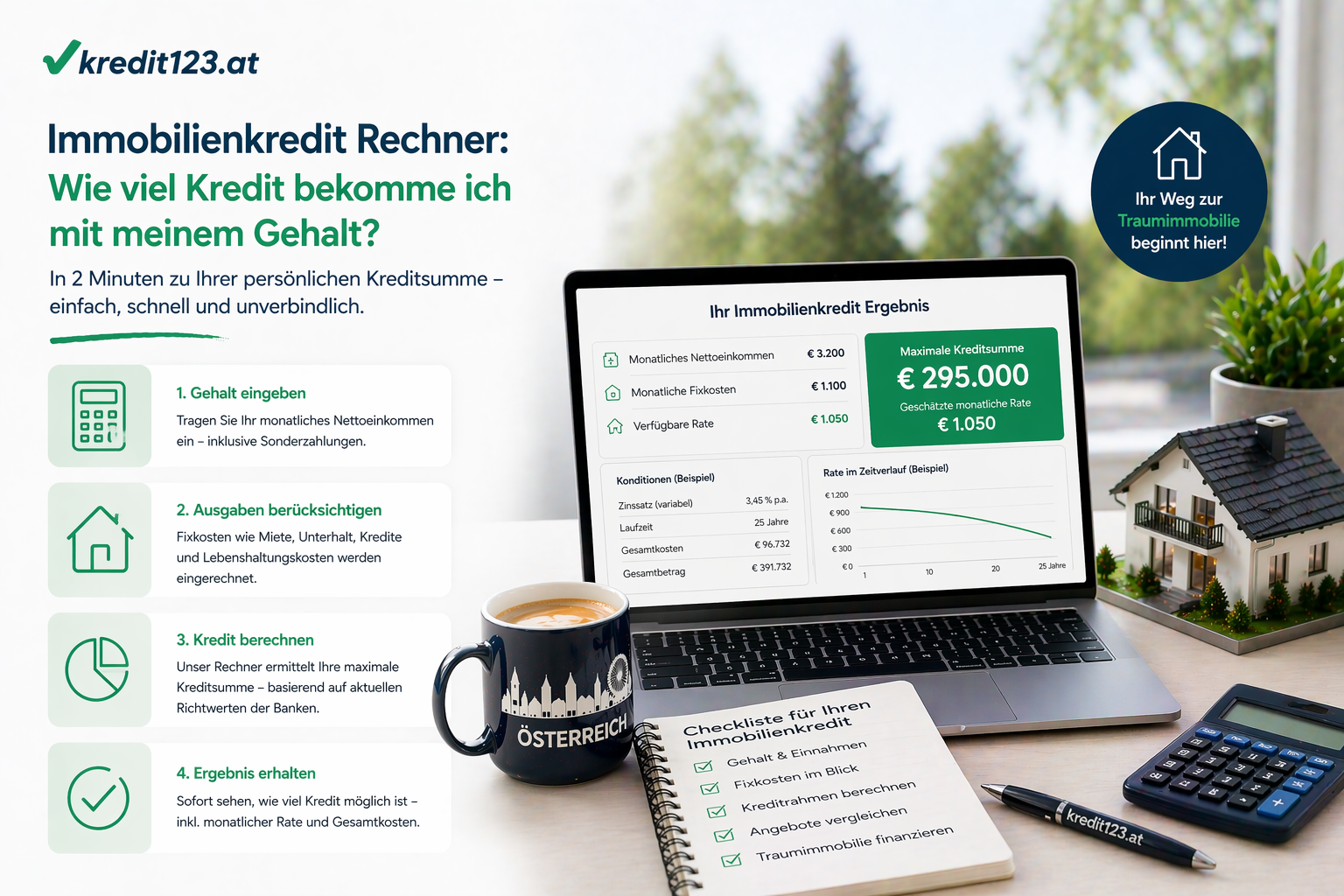
Mortgage Calculator Austria: How Much Can You Borrow Based on Your Salary?
Mortgage Calculator: How much mortgage can I get with my salary in Austria? "How much mortgage can I get with my salary?" — this is the first question almost everyone asks before even starting to look for a property. The answer depends on more than just your salary. This article explains the exact calculation, provides concrete tables for various income situations, and shows what you can do to increase your maximum loan amount when looking for a property loan Austria.
Read more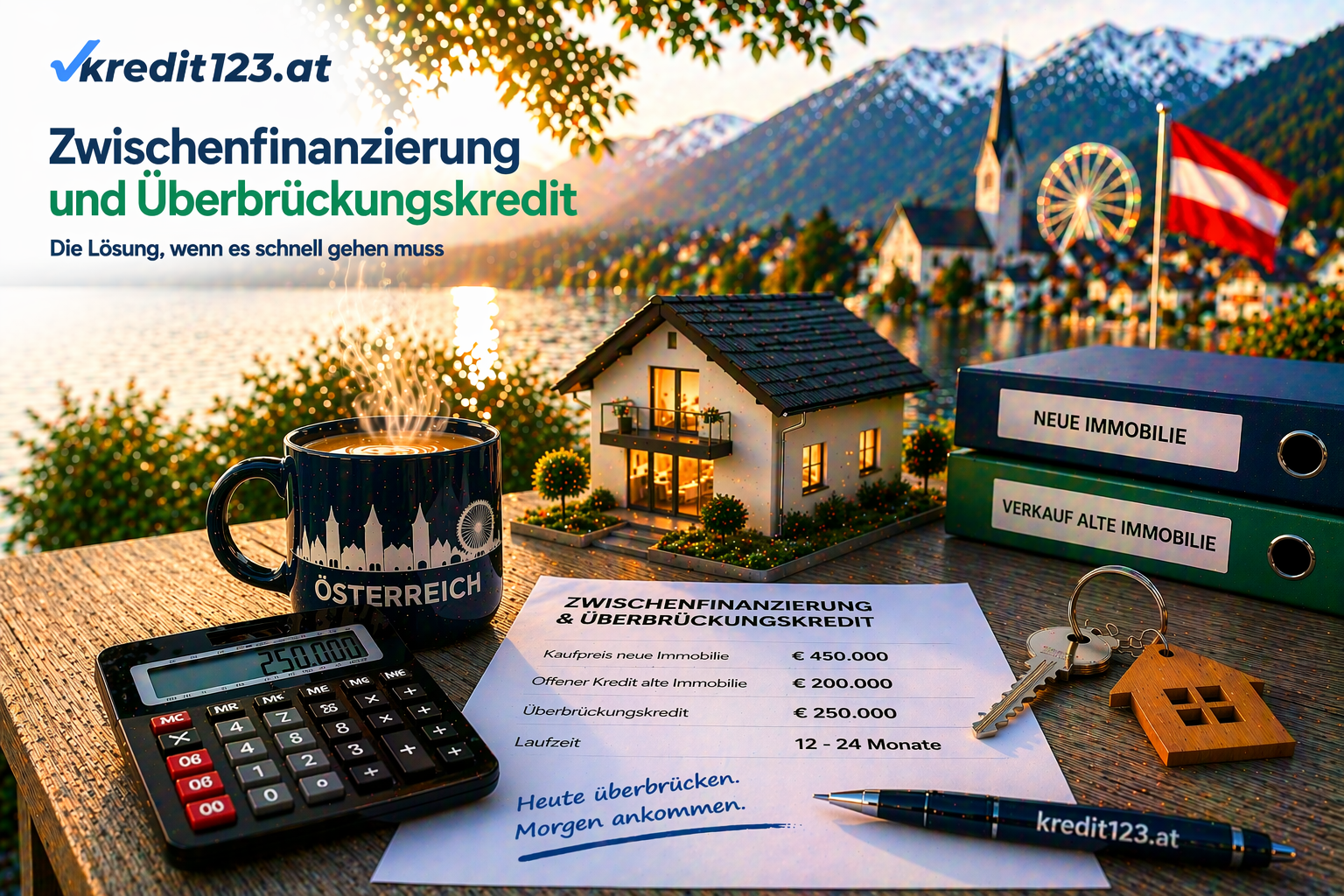
Bridging Loans for Property in Austria: Tips & Costs for Expats
Bridging finance for property purchase in Austria: When your new home arrives before your old one sells. You've found your dream apartment – but your current property isn't sold yet. This situation is common for many property buyers in Austria – and it has a name: bridging finance. This article explains how it works, what it costs, when it makes sense, and when it should be avoided for expats looking to buy property in Austria.
Read more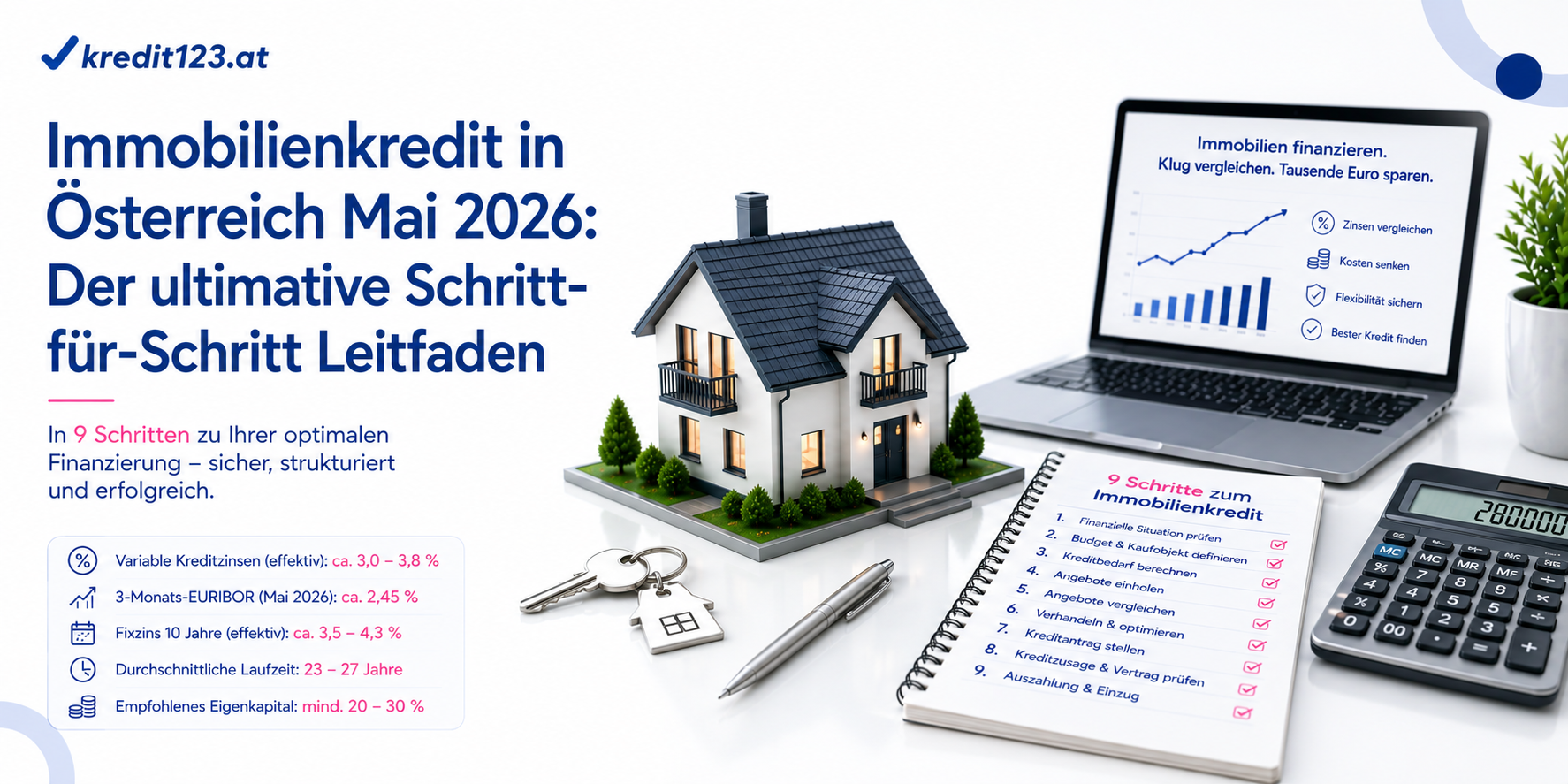
Immobilienkredit Österreich 2026: Leitfaden zur Finanzierung
Immobilienkredit in Österreich 2026: Der ultimative Schritt-für-Schritt LeitfadenDieser Leitfaden ist die wohl fast vollständige Antwort auf alle Frag...
Read moreQuestions about your financing?
Our experts advise you personally and find the optimal solution for your property financing in Austria.