
Buying vs. Renting Property in Austria 2026: The Ultimate Comparison for Expats
Buying vs. Renting an apartment in Austria in 2026: An honest calculation for your property loan. This guide helps expats understand the financial implications of buying vs. renting, incorporating key metrics and real-world examples for the Austrian real estate market.
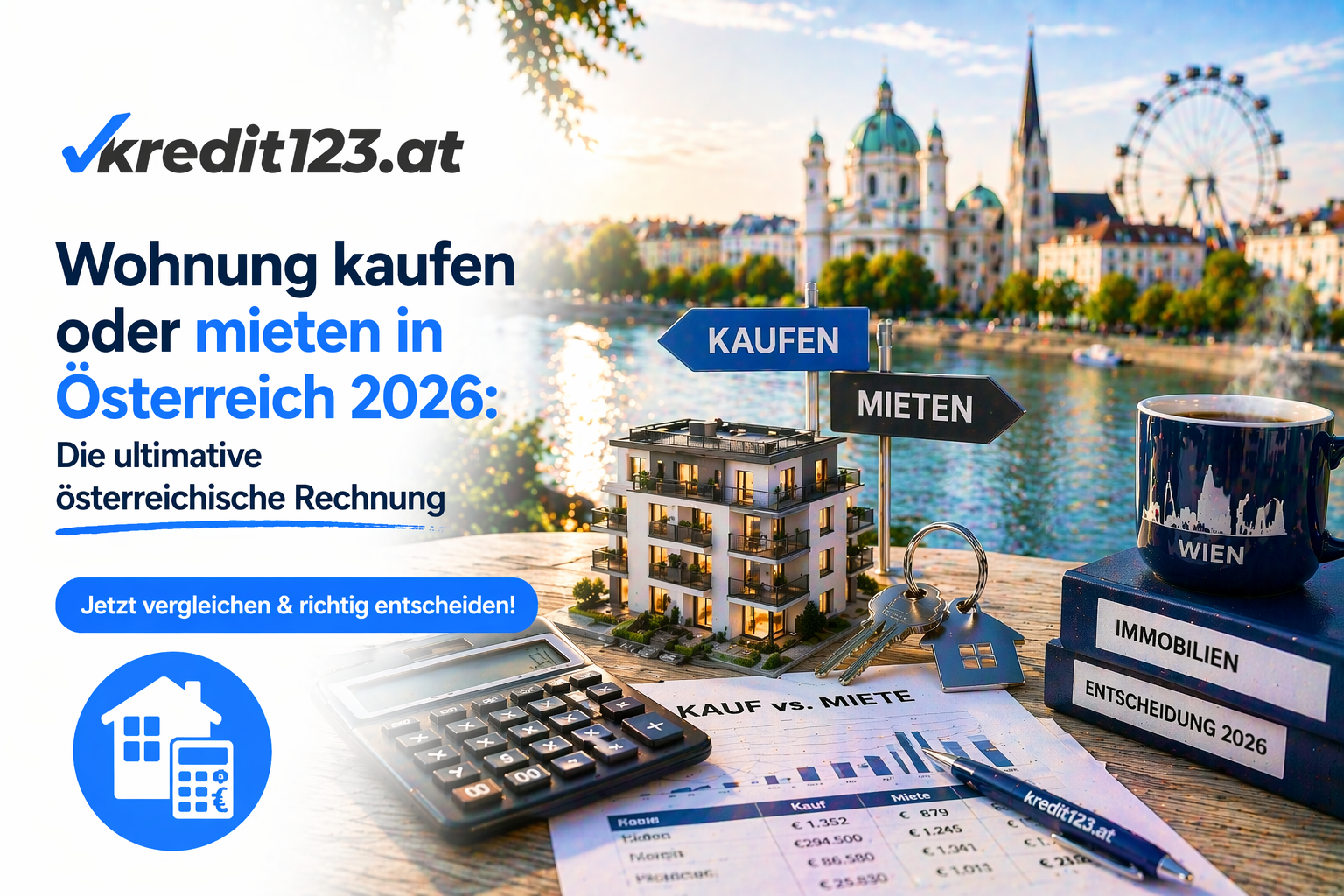
Buying vs. Renting an Apartment in Austria 2026: An Honest Calculation for Your Property Loan
kredit123.at · Guide · Topic: Buying or renting in Austria, buying or renting in Vienna, is buying worth it in 2026 · As of April 2026
To buy or to rent — in Austria, this isn't a philosophical question, but a mathematical one. One with many variables that differ from person to person. This article provides the numbers, the method, and an honest assessment — without promoting either option.
Why the Answer to This Question is Different in 2026 Than Three Years Ago
In 2021 and 2022, the answer seemed clear: buying was better. Property prices rose by five to ten percent annually, mortgage Austria rates were below one percent, and rents also increased sharply. Those who could buy, did.
Then came the interest rate turnaround. The ECB raised key interest rates from 0 to over 4 percent within 14 months. Property loans in Austria suddenly became much more expensive. Demand for purchases plummeted. Property prices corrected themselves — in Vienna and other Austrian cities, sometimes by ten to twenty percent from their peak.
In 2026, the picture has shifted again: the ECB has lowered interest rates multiple times, property loans in Austria are cheaper, and property prices are starting to rise slightly again in sought-after locations. The question of buying or renting is thus open again — and the answer depends more than ever on your individual situation. Use our rent vs. buy calculator to get an initial feel for your situation.
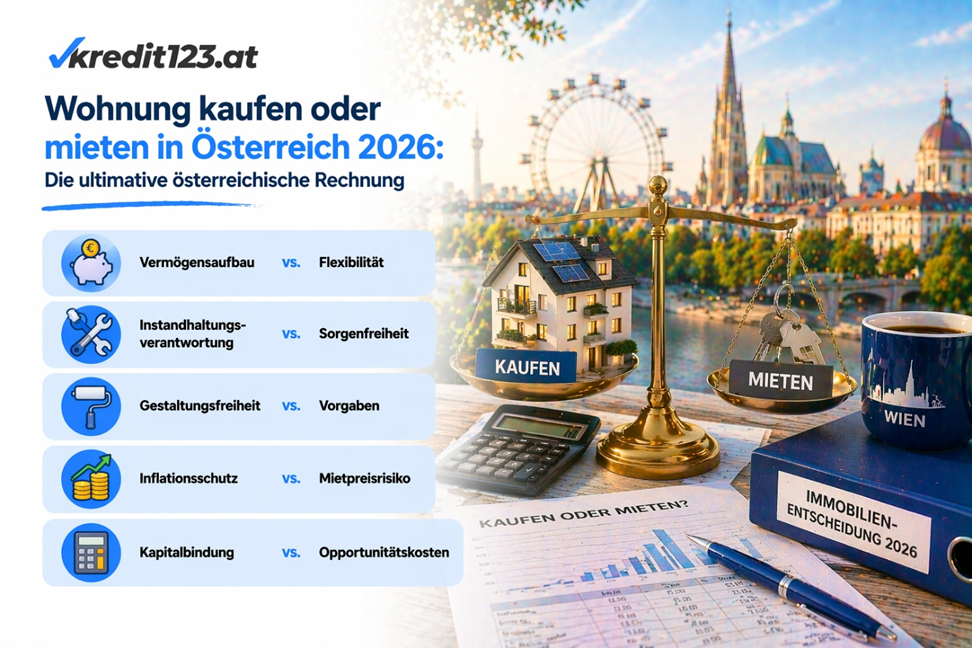
The Key Metric: The Price-to-Rent Ratio
The Price-to-Rent Ratio is the most important objective metric when comparing buying and renting. It shows how many years of rent you would need to pay to cover the purchase price of a comparable property.
Calculation: Purchase Price ÷ Annual Net Rent = Price-to-Rent Ratio
Interpreting the Results:
Below 20: Buying tends to be cheaper
20 to 25: Balanced — depends on other factors
25 to 30: Renting tends to be cheaper
Above 30: Renting is generally significantly cheaper
Current indicative values for Austrian cities and regions in 2026:
Region | Avg. Purchase Price Apartment 70 m² | Avg. Net Rent 70 m² | Price-to-Rent Ratio |
|---|---|---|---|
Vienna Inner Districts (1st–9th) | 550,000 – 850,000 € | 1,200 – 1,800 €/month | approx. 28–35 |
Vienna Outer Districts (10th–23rd) | 300,000 – 500,000 € | 900 – 1,400 €/month | approx. 22–28 |
Graz | 250,000 – 400,000 € | 800 – 1,200 €/month | approx. 22–27 |
Salzburg City | 400,000 – 650,000 € | 1,100 – 1,600 €/month | approx. 25–32 |
Innsbruck | 380,000 – 600,000 € | 1,000 – 1,500 €/month | approx. 25–30 |
Linz | 200,000 – 320,000 € | 700 – 1,100 €/month | approx. 20–26 |
Lower Austria "Speckgürtel" (commuter belt) | 250,000 – 420,000 € | 800 – 1,200 €/month | approx. 20–27 |
Rural Regions | 100,000 – 250,000 € | 500 – 900 €/month | approx. 14–22 |
All figures are rough estimates without guarantee. Actual prices and rents vary significantly depending on location, condition, and amenities. As of: April 2026.
What these numbers mean: In Vienna's inner districts — with a price-to-rent ratio sometimes exceeding 30 — you would pay 30 years of net rent to reach the purchase price. Purely mathematically and without considering interest, this is a strong argument for renting. In rural regions with a ratio below 20, the picture reverses.
However, the price-to-rent ratio is only one indicator — it ignores interest, taxes, maintenance, and appreciation. The complete calculation is more complex.
The Full Comparative Calculation: What Buying Really Costs
When you buy property in Austria, you don't just pay the purchase price. The true costs of ownership include several components that must all be considered when comparing with renting.
One-time Costs of Buying (Ancillary Purchase Costs in Austria)
Cost Item | Amount |
|---|---|
Real Estate Transfer Tax (Grunderwerbsteuer) | 3.5 % of purchase price |
Land Register Entry (Grundbucheintragung) for Ownership | 1.1 % of purchase price |
Land Register Entry (Grundbucheintragung) for Mortgage (Pfandrecht) | 1.2 % of loan amount |
Notary / Lawyer Fees | approx. 1.0–2.0 % of purchase price |
Real Estate Agent Commission (Maklercourtage) | max. 3 % plus VAT |
Bank Valuation Fee (Schätzgebühr) | 500–1,500 € |
Total Ancillary Costs | approx. 8–12 % of purchase price |
For a purchase price of 350,000 Euros, this means: 28,000 to 42,000 Euros in ancillary costs — which are lost regardless of what happens next. Calculate this precisely with our ancillary costs calculator.
Ongoing Costs of Ownership
In addition to the mortgage Austria payment, owners incur other costs that renters do not, or hardly ever, bear:
Maintenance Reserve (Instandhaltungsrücklage): 1,500 – 4,000 € p.a.
Property Management (Hausverwaltung): 300 – 800 € p.a.
Repairs: approx. 0.5–1 % of property value annually.
Property Tax & Insurance (Grundsteuer & Versicherungen): approx. 400 – 1,300 € p.a.
These costs are generally borne by the landlord for a rental apartment. When buying, the owner bears them themselves.
The Opportunity Cost Argument — What Your Equity Could Otherwise Earn
An often-overlooked factor: the equity invested in property is tied-up capital. 80,000 Euros of equity invested in an apartment cannot simultaneously be invested elsewhere. The opportunity costs — i.e., the lost return from an alternative investment — should be considered in a fair comparative calculation.
The Full Comparative Calculation: What Renting Really Costs
Renting often sounds like "burning money" — a persistent prejudice that isn't entirely true.
What Actually Happens When You Rent
You pay for living space without building equity — that's true.
You are flexible and don't have a concentrated risk in a single property.
You don't pay ancillary costs upon moving in, no maintenance, no property tax.
Your equity can be invested in the capital market (e.g., ETFs).
The decisive argument for renting: If you consistently invest the difference between rental costs and buying costs, you can achieve a similar asset outcome as a property owner over a long period. However, this requires high financial discipline.
The Example Calculation: Buying vs. Renting in Vienna — A Detailed Breakdown
Starting point: 70-m² apartment in Vienna, 14th district.
Parameter | Buying | Renting |
|---|---|---|
Purchase Price / Rent | 370,000 € | 1,200 €/month net |
Equity | 80,000 € | — |
Loan Amount | 290,000 € | — |
Interest Rate / Term | 3.5 % / 25 years | — |
Monthly Mortgage Payment | approx. 1,450 € | — |
Operating Costs (Betriebskosten) | approx. 250 €/month | approx. 250 €/month |
Maintenance | approx. 200 €/month | — |
Total Monthly Burden | approx. 1,900 € | approx. 1,450 € |
The additional monthly burden when buying is approx. 450 Euros. In return, you build equity monthly through repayment.
After 25 Years:
Buyer: Property debt-free. Value with 1-2% increase: approx. 550,000 – 600,000 €.
Renter: If the difference and equity are invested (5-7% return): Portfolio value approx. 300,000 – 450,000 € (before taxes).
This calculation is a highly simplified illustration without guarantee.
When Buying is Clearly the Better Decision
Long-term Stay: Those who stay 10+ years amortize the ancillary costs.
Affordable Region: Price-to-rent ratio below 20 (e.g., Burgenland, rural Lower Austria).
Inflation Protection: Protection against future rent increases in old age.
Freedom to Customize: Renovations and pets without needing permission.
When Renting is Clearly the Better Decision
High Mobility: Professionally motivated moves in the foreseeable future.
Expensive Market: Price-to-rent ratio above 30 (Vienna city center, Salzburg City).
Low Equity: Too high interest burden and risk with a low equity ratio (referencing the KIM-Verordnung, which sets strict lending criteria in Austria).
Uncertain Income: Transitional phases such as job changes or starting a business.
The Special Case of Vienna: Why the Capital Has Its Own Logic
Vienna is the only real estate market in Austria that truly needs to be compared with other major European cities. A significant portion of Vienna's rental market is regulated by Gemeindebau (municipal housing) and cooperatives. Owning such an apartment provides a rental position that is almost unbeatable compared to buying. In outer districts, however, the ratio is often more favorable for buying (22-26).
What Financing Has to Do with the Decision
A good mortgage Austria comparison can massively influence the calculation. For a 290,000 Euro loan, a 0.5% lower interest rate saves approximately 22,500 Euros over the term. If you already have an expensive loan, consider the option to refinance your loan.
The Honest Summary: No Universal Right or Wrong
Buying or renting is a trade-off between financial outcome, personal situation, and psychological value. The most important decision is an informed one, based on real numbers.
Are you planning to buy property in Austria? Let's calculate together. Request a non-binding financial consultation now and find the optimal property loan in Austria for your project. We specialize in expat mortgage and real estate financing Austria solutions.
Request a non-binding financial consultation now
This article is for general information purposes only and does not replace individual advice. Property prices and interest rates are subject to market fluctuations.
Useful Tools for Your Financing
Related Articles

Buying Property in Austria for Families in 2026: Leveraging an Inheritance
Buying Property in Austria for Families in 2026: With a small inheritance or family support, you can achieve homeownership. Learn how to leverage these funds for your expat mortgage in Austria.
Read more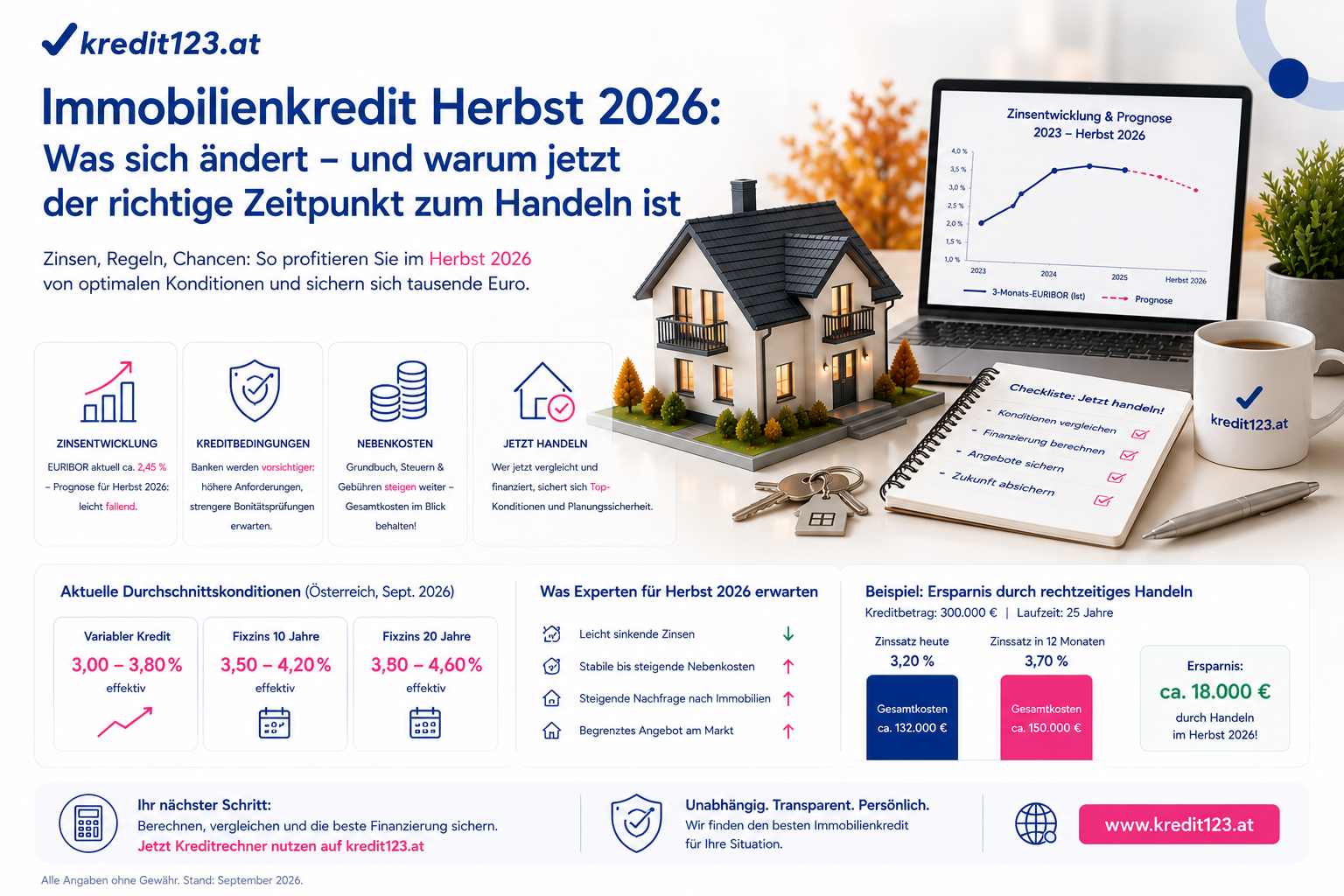
ECB Interest Rate Decision Sept. 2026: Implications for Home Loans in Austria
ECB Interest Rate Decision September 2026: What it means for your property loan in Austria. Stay informed about EURIBOR, current mortgage rates, and how to optimize your expat mortgage.
Read more
Immobilienkredit umschulden Österreich 2026: Zinsen & Tipps
Immobilienkredit umschulden in Österreich 2026: Für wen es sich wirklich auszahltkredit123.at · Ratgeber · Thema: Umschuldung Immobilienkredit Österre...
Read moreQuestions about your financing?
Our experts advise you personally and find the optimal solution for your property financing in Austria.