
Mortgage Term in Austria: Costs & Tips for Expats
Understanding your mortgage term in Austria is crucial for expats looking to buy property. Learn how loan duration impacts costs, monthly payments, and overall financial burden. Discover tips for choosing the optimal term for your expat mortgage in Austria.
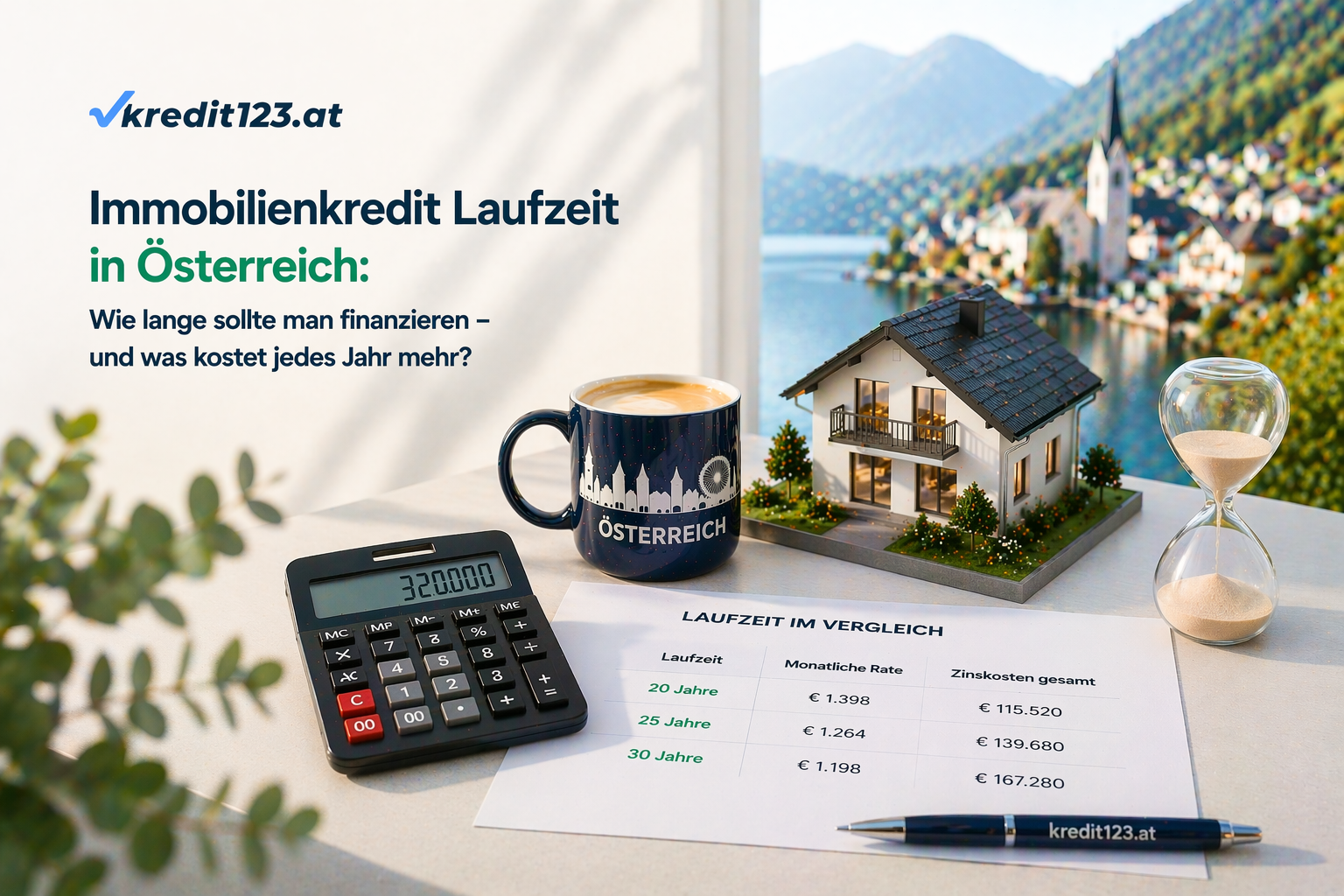
Mortgage Term in Austria: How Long Should You Finance – and What Does Each Extra Year Cost?
After the interest rate, the loan term is the most crucial adjustable factor for your mortgage in Austria — and often the least understood. Most borrowers choose the longest possible term because it results in the lowest monthly payment. This article will explain what that means in terms of additional costs over thirty years, when a shorter term is a better decision, and how to find the optimal term for your specific situation when you want to buy property in Austria.
Before committing, you should start an independent mortgage comparison to see the impact of the term on your interest costs in black and white.
What Loan Term Really Means — The Basic Principle of Property Financing
The term of a property loan is the period over which the entire borrowed amount is repaid — including all interest. In Austria, terms of fifteen to thirty-five years are common, with the most frequent range being between twenty and thirty years. This is a key consideration for any expat mortgage.
What many don't understand: The term not only determines the monthly payment — it also determines how much money goes to the bank in total. And this difference is significant.
The Basic Principle of Annuity for Home Loans
With a classic annuity loan — the standard for property loan Austria — the monthly payment remains constant throughout the entire term. However, what continuously changes is the composition of this payment.
Initially, the payment consists almost entirely of interest — because the outstanding debt is high. With each payment, the outstanding debt decreases slightly, thus reducing the interest on the remaining debt, and the principal repayment portion automatically increases.
Specifically: For a loan of 280,000 Euros, interest rate 3.5%, term 25 years:
Time | Monthly Payment | Interest Portion | Principal Portion | Remaining Debt |
|---|---|---|---|---|
Month 1 | €1,400 | €817 | €583 | €279,417 |
Year 5 | €1,400 | €737 | €663 | €252,800 |
Year 10 | €1,400 | €628 | €772 | €215,400 |
Year 15 | €1,400 | €490 | €910 | €168,000 |
Year 20 | €1,400 | €311 | €1,089 | €107,000 |
Year 25 | €1,400 | €4 | €1,396 | €0 |
Illustrative calculation without guarantee.
What this table shows: In the first few years, you pay almost exclusively interest — the outstanding debt barely decreases. Only in the last third of the term does the principal repayment accelerate significantly. This is not arbitrary on the bank's part — it's a mathematical necessity.
What Each Additional Year Truly Costs
This is the core of this article — and the figure that surprises most people. Each additional year of the loan term lowers the monthly payment — which looks good. But each additional year also means more interest payments to the bank — which you only see when you look at the total costs. This is crucial for anyone considering a mortgage Austria.
Comparison Table: 280,000 Euro Loan, Interest Rate 3.5%
Term | Monthly Payment | Total Interest | Total Cost | Difference to 20 Years |
|---|---|---|---|---|
15 Years | €2,001 | €80,180 | €360,180 | −€56,920 |
20 Years | €1,623 | €109,520 | €389,520 | Base |
25 Years | €1,400 | €140,000 | €420,000 | + €30,480 |
30 Years | €1,257 | €172,520 | €452,520 | + €63,000 |
35 Years | €1,157 | €206,440 | €486,440 | + €96,920 |
Illustrative calculation without guarantee. Assumes a constant interest rate.
What this table shows: The difference between a 20-year and a 35-year term for this loan is almost 97,000 Euros in additional costs — for a monthly saving of only 466 Euros. You pay almost a third of the original loan amount extra in interest — just because you finance for fifteen years longer. This is a critical point for real estate financing Austria.
Or to put it another way: The 466 Euro monthly saving from the longer term costs a total of 97,000 Euros over 35 years. That's a very expensive safety cushion. Before deciding on a term, you should calculate your ancillary costs to keep the overall budget in mind.
Comparison Table: 200,000 Euro Loan, Interest Rate 3.5%
Term | Monthly Payment | Total Interest | Total Cost |
|---|---|---|---|
15 Years | €1,430 | €57,400 | €257,400 |
20 Years | €1,160 | €78,400 | €278,400 |
25 Years | €1,000 | €100,000 | €300,000 |
30 Years | €898 | €123,280 | €323,280 |
Comparison Table: 400,000 Euro Loan, Interest Rate 3.5%
Term | Monthly Payment | Total Interest | Total Cost |
|---|---|---|---|
15 Years | €2,859 | €114,620 | €514,620 |
20 Years | €2,321 | €157,040 | €557,040 |
25 Years | €2,001 | €200,300 | €600,300 |
30 Years | €1,796 | €246,560 | €646,560 |
35 Years | €1,654 | €294,680 | €694,680 |
The most important result from all three tables: The monthly saving from a longer term is moderate in absolute terms — the additional costs over the total term are substantial. Those who understand this calculation make more informed decisions. Use the loan calculator on kredit123.at to perform this calculation for your specific loan amount and interest rate, especially when considering an expat mortgage.
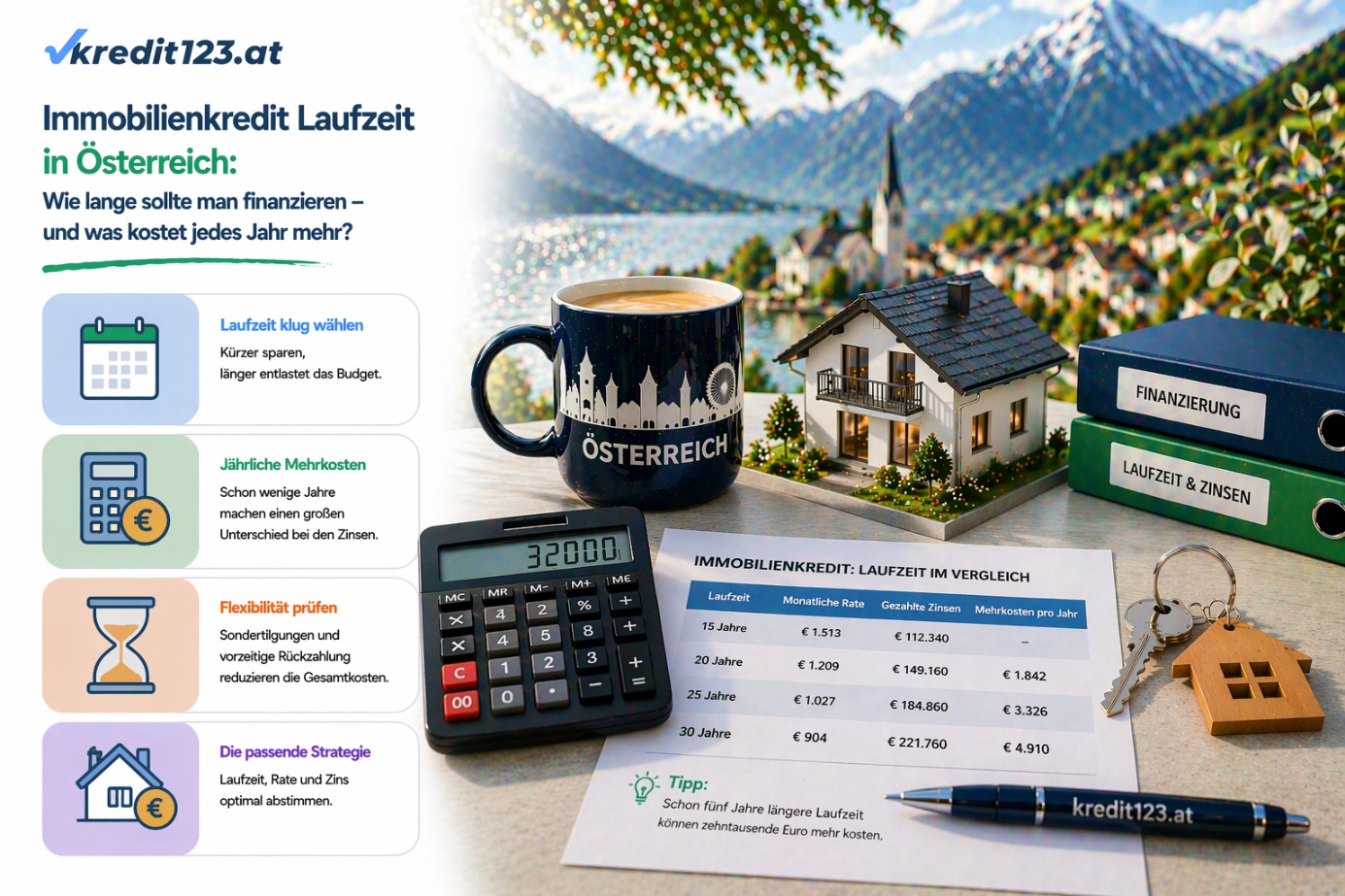
What Limits the Maximum Loan Term in Austria
Legal and Regulatory Limits
After the expiration of the KIM-Verordnung (Credit Institution Mortgage Ordinance) on 30 June 2025, there is no longer a legal maximum term for mortgages in Austria. The KIM-V had prescribed an upper limit of 35 years — this formally no longer applies.
In practice, most Austrian banks have internally maintained a maximum term of 30 to 35 years — because it is prudent lending practice, regardless of legal requirements. This is important for expats looking to buy property Austria.
Borrower's Age as a Decisive Limit
This is the most important practical restriction when choosing the loan term: The maximum age of the borrower at the end of the loan term. Most Austrian institutions have internally stipulated that the loan must be fully repaid by a certain age — typically between 75 and 80 years. This significantly impacts your options for a property loan Austria.
This has direct implications for the maximum possible term:
Age at Loan Application | Max. Term up to 75 Yrs. | Max. Term up to 80 Yrs. |
|---|---|---|
30 Years | 45 Years (internally usually limited to 35) | 50 Years (internally usually limited to 35) |
35 Years | 40 Years (internally usually limited to 35) | 45 Years (internally usually limited to 35) |
40 Years | 35 Years | 40 Years (internally usually limited to 35) |
45 Years | 30 Years | 35 Years |
50 Years | 25 Years | 30 Years |
55 Years | 20 Years | 25 Years |
60 Years | 15 Years | 20 Years |
65 Years | 10 Years | 15 Years |
What this means: If you take out a loan at 55, with an age limit of 80, you get a maximum term of 25 years — even if you'd prefer 30 years. If you take out a loan at 40, you generally have full flexibility. For two applicants, the bank usually bases its decision on the age of the older partner. This is a key factor for an expat mortgage.
Affordability as a Practical Limit
Regardless of maximum terms, there is another limit: The monthly payment must be affordable. Banks internally adhere to a debt service ratio — the total monthly burden from loan payments should not exceed 35 to 40 percent of net income. This is no longer a legal limit but an internal bank guideline that remains in practice. This impacts your ability to secure a mortgage Austria.
This limit can force a shorter term — if the income is high enough to cover a higher payment — or necessitate a longer term — if the income doesn't allow for the payment with a shorter term.
When a Shorter Term is the Better Decision
If income allows: Those who can comfortably afford the higher payment of a shorter term will save money in the long run. 'Comfortably' means the payment still leaves room for holidays, maintenance, and retirement savings. This is a smart approach for real estate financing Austria.
If you want to be debt-free by retirement: If you buy at 35 and retire at 65, you should choose a 30-year term. This way, the burden disappears exactly when your income decreases.
If special repayments are planned: Those expecting inheritances or bonuses can choose a longer term for daily flexibility and reduce costs through targeted repayments.
Important note: The right to make special repayments must be contractually agreed upon. If you already have a loan, you should regularly check for refinancing options to benefit from better conditions.
When a Longer Term is the More Sensible Choice
If income is tight: For first-time buyers, a lower payment is often a necessity. You choose the long term and adjust later with special repayments. This can be a practical strategy for an expat mortgage.
If income is expected to grow: Young professionals with anticipated significant salary increases in the future benefit from the initially low burden.
If flexibility is more important than optimization: Those who want to invest in parallel or need liquidity for other projects consciously opt for higher interest costs in favor of liquidity. This is a common consideration for property loan Austria.
Loan Term and Interest Rate: How Both Parameters are Related
The loan term and interest rate influence each other. Some banks offer slightly better interest rates for shorter terms, as the risk is lower. In a mixed model (e.g., 10 years fixed, then variable), the fixed-interest period is often shorter than the total term. For variable loans, the term is generally more flexible, as special repayments are often possible at any time.
Shortening the Term: What a Special Repayment Really Achieves
A special repayment is one of the most effective tools to reduce total interest costs. Here's an example for a 280,000 Euro loan (3.5%, 30 years, payment: 1,257 Euros):
Without special repayment: Total interest 172,520 Euros.
With a 20,000 € special repayment after Year 5: Interest savings approx. 14,000 to 18,000 Euros, term reduction by approx. 4 years.
With a 50,000 € special repayment after Year 5: Interest savings approx. 35,000 to 45,000 Euros, term reduction by approx. 10 years.
What to Consider for Special Repayment Rights
Loan Type | Typical Special Repayment Rights |
|---|
Useful Tools for Your Financing
Related Articles

Buying Property in Austria for Families in 2026: Leveraging an Inheritance
Buying Property in Austria for Families in 2026: With a small inheritance or family support, you can achieve homeownership. Learn how to leverage these funds for your expat mortgage in Austria.
Read more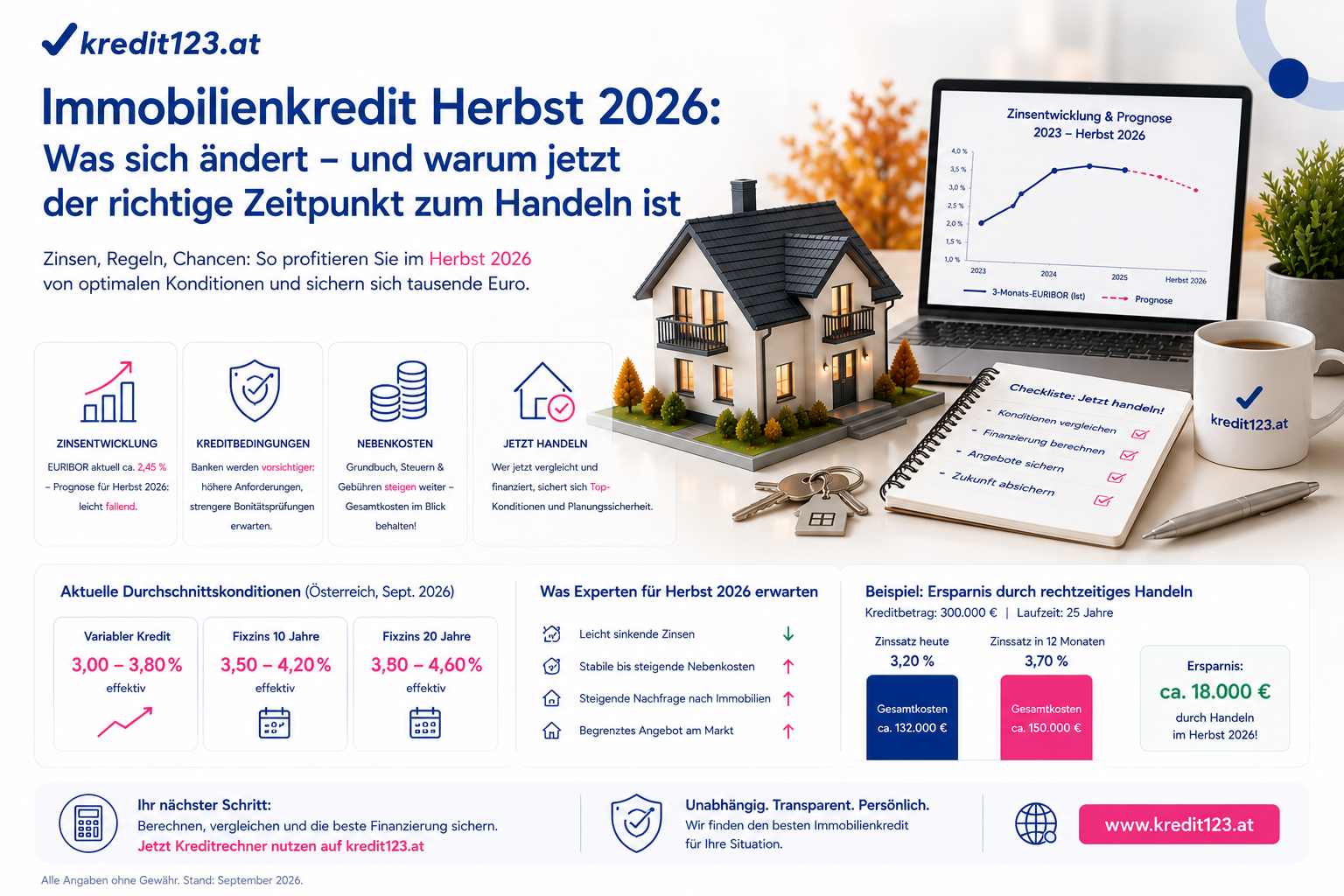
ECB Interest Rate Decision Sept. 2026: Implications for Home Loans in Austria
ECB Interest Rate Decision September 2026: What it means for your property loan in Austria. Stay informed about EURIBOR, current mortgage rates, and how to optimize your expat mortgage.
Read more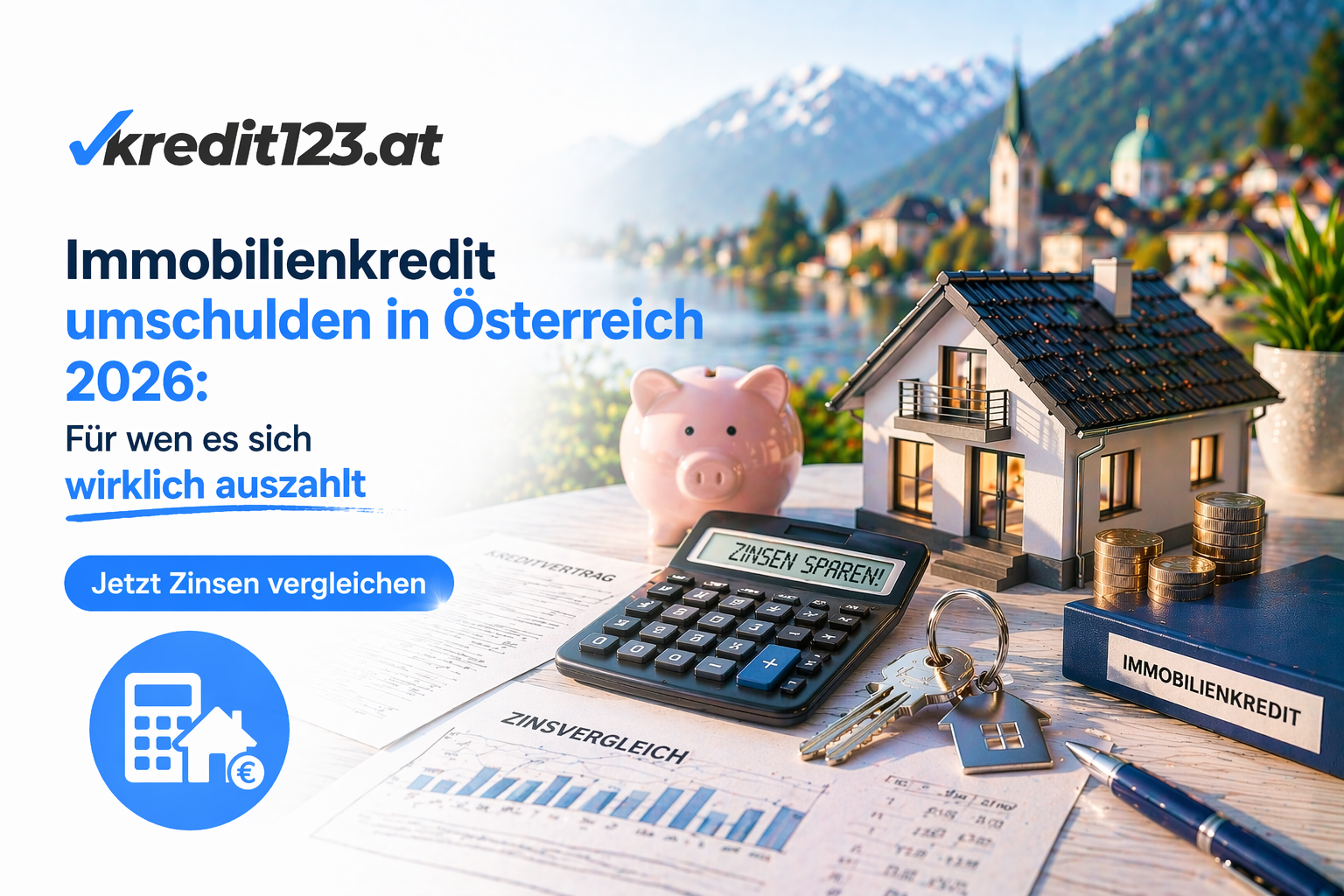
Immobilienkredit umschulden Österreich 2026: Zinsen & Tipps
Immobilienkredit umschulden in Österreich 2026: Für wen es sich wirklich auszahltkredit123.at · Ratgeber · Thema: Umschuldung Immobilienkredit Österre...
Read moreQuestions about your financing?
Our experts advise you personally and find the optimal solution for your property financing in Austria.