
Property Loan with Low Down Payment in Austria: What's Possible in 2026?
Property loan with low down payment in Austria: What's possible in 2026? For years, anyone looking to buy property in Austria but without substantial savings faced a clear legal hurdle: the KIM-Verordnung with its 20% down payment requirement. This regulation expired on 30 June 2025 and was not extended. This guide explains what this means for buyers with low down payments, what new opportunities are available, and what banks still require.
Property Loan with Low Down Payment in Austria: What's Possible in 2026?
For years, anyone looking to buy property in Austria but without substantial savings faced a clear legal hurdle: the KIM-Verordnung (Credit Institutions Real Estate Financing Measures Ordinance) with its 20% down payment requirement. This regulation expired on 30 June 2025 and was not extended. This guide explains what this means for buyers with low down payments, what new opportunities are available, and what banks still require.
What Changed Since 30 June 2025: End of the KIM-Verordnung
The Kreditinstitute-Immobilienfinanzierungs-Maßnahmen-Verordnung (KIM-V), or Credit Institutions Real Estate Financing Measures Ordinance, was in effect from August 2022 until 30 June 2025. It stipulated:
A minimum of 20% down payment (Eigenkapital) relative to the purchase price
A maximum debt service ratio of 40% of net income
A maximum loan term of 35 years
Since the regulation expired on 30 June 2025, there is no longer a statutory minimum down payment requirement for property loans in Austria. This is a significant change – and one that opens up new possibilities for many aspiring homeowners, including expats looking for an expat mortgage in Austria.
What This Means in Practice
Banks are no longer legally obliged to demand a 20% down payment. Theoretically, they can now grant mortgages in Austria with 10% or even less down payment – provided the borrower's creditworthiness is strong and their internal risk assessment allows it.
In practice, however, this does not mean that banks will suddenly approve all applications with minimal down payments. Banks have their own internal guidelines, risk models, and regulatory requirements that continue to apply independently of the KIM-V. The down payment question remains relevant – it is simply no longer rigidly fixed by law.
What Still Applies
Even without the KIM-V, Austrian banks will continue to carefully assess:
Creditworthiness and income stability – this was standard even before the KIM-V.
Affordability of the monthly installment – every bank checks an internal debt service ratio, even without a legal requirement.
Market value of the property – the property must be suitable as collateral for your property loan Austria.
Origin of the down payment – anti-money laundering regulations remain unchanged.
Loan term – even without a legal maximum, there are internal upper limits, usually 30 to 35 years.
The difference from the KIM-V era: these parameters are now assessed individually again, not according to a uniform legal template. This creates more flexibility – but also more differences between institutions, which is good news for those seeking real estate financing Austria.
How Much Down Payment Do You Really Need in 2026?
There is no longer a blanket answer – and this is both an opportunity and a challenge.
What has been observed in practice since 30 June 2025: Many banks have cautiously relaxed their internal guidelines, but not abolished them. Most Austrian institutions still require 10 to 20% down payment – not because they have to, but because they consider it prudent lending practice.
A rough guide for 2026:
Down Payment Ratio | Realistic Market Outlook |
|---|---|
Under 10% | Very difficult, only in exceptional cases with very strong creditworthiness |
10 – 15% | Possible with good creditworthiness, stable income, good property location |
15 – 20% | Good starting position, most institutions open |
Over 20% | Best conditions, maximum negotiation leverage |
This assessment is based on market observations and may vary depending on the institution, borrower profile, and region.
The crucial point: where there used to be a hard limit, there is now room for negotiation. Anyone with a convincing overall profile – stable income, clean KSV (credit report), good property – can now secure a mortgage Austria with less down payment than a year ago.
Why the Down Payment Problem Still Persists
The end of the KIM-V does not fully solve the structural problem. The reasons why people have low down payments are not tied to a regulation.
Young Professionals and Families
Those looking to buy property in Austria at 28 or 32 have often been paying high rents in an expensive city for years. What's left for savings rarely amounts to more than 10 to 15% of a purchase price in Vienna or Salzburg. This is not a matter of discipline – it's mathematics.
After a Divorce
A separation often frees up capital but also creates new liabilities. Someone leaving a shared property and wanting to start anew may have received a settlement amount that is barely enough for re-entry. At the same time, maintenance payments burden the debt service ratio.
Good Income, Little Wealth
A doctor after university, a lawyer in their first job, an engineer after their master's degree – they often have a solid or growing income but little saved capital. Banks can now assess this individually, instead of rejecting it by default.
Renters in Expensive Areas
Someone paying €1,500 in rent in Vienna or Innsbruck saves structurally less than someone in Wels or Klagenfurt. The down payment problem is often a direct result of high rental costs in previous years.
The Most Important Strategies with Low Down Payment
Strategy 1: Compare More Banks – Differences Are Now Greater
Since the end of the KIM-V, there is no longer a uniform limit. This means that the differences between institutions have grown. One bank might finance with 12% down payment, while the next still requires 20%. If you only inquire with one bank, you won't see the full picture.
This is the strongest lever for buyers with low down payments: don't just take the first best bank, but specifically find those institutions that are open to your specific profile. An independent mortgage broker knows the current internal guidelines of the institutions – and can make targeted inquiries without multiple KSV (credit report) impacts.
Strategy 2: Fully Account for Your Down Payment
Many borrowers underestimate their actual down payment. Eligible own funds include:
Savings accounts, call money, fixed deposits
Bausparverträge (building society savings contracts) and Bauspardarlehen (building society loans)
Securities accounts (with a discount depending on composition)
Surrender value of life insurance policies
Gifts from family members (documented)
Owner-provided labor for house construction (with some institutions)
Parental property as additional collateral (cross-collateralization)
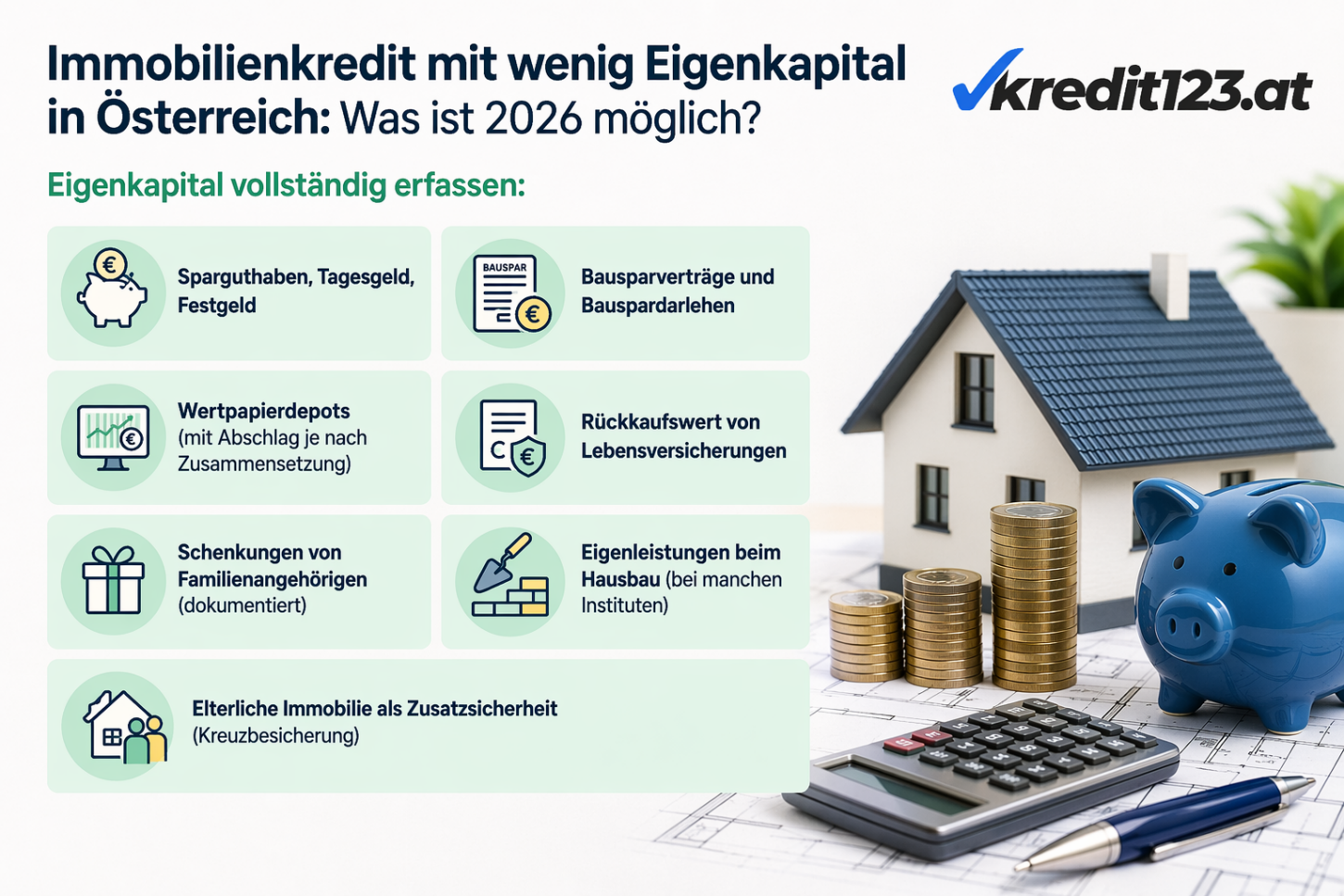
If you add all this up, you often find you have more than you thought for your expat mortgage.
Strategy 3: Utilize Family Support Structurally
Gifts from parents or grandparents are tax-uncomplicated in Austria – there has been no gift tax since 2008. However, the bank must be able to trace the origin of the money: gift agreement or written confirmation, bank statements proving the flow of funds.
An alternative to a cash gift: parents provide their own property as additional collateral. The bank then receives not only the new property as a pledge but also the parental one – which improves the loan-to-value ratio and effectively solves the down payment problem. This so-called Kreuzbesicherung (cross-collateralization) is possible but a significant decision for all parties involved – it should be legally documented carefully.
Strategy 4: Bausparvertrag as Supplementary Financing
An Austrian Bausparvertrag (building society savings contract) can be used as supplementary financing for a bank loan. The Bauspardarlehen (building society loan) often has more favorable interest rates than a regular bank loan because it is financed from a collective savings model.
The catch: the full Bauspar sum is only available after the minimum savings period (usually six years). If you want to buy property in Austria now, you need a Bausparvertrag from six years ago. If you don't have one yet: sign up now and use it for a later purchase or follow-up financing.
Strategy 5: Check Provincial Housing Subsidies (Wohnbauförderung)
Several federal states (Bundesländer) offer low-interest loans for first-time buyers, which can act as supplementary financing. Vienna, Lower Austria, and Styria have programs specifically designed for first-time buyers with moderate incomes. These can be a great help for expats navigating real estate financing Austria.
Important: Subsidy applications usually must be submitted before the purchase. Allow for processing time – several months is realistic.
Strategy 6: Start with a More Affordable Property
If you cannot finance your dream property with your current down payment, you can start smaller. An apartment in a less central location, a property in need of renovation, or a smaller area reduces the purchase price and thus the absolute down payment requirement.
The plan: get started, service the loan, build equity through time and amortization, and upgrade in a few years. Buying twice means paying ancillary costs twice – but for some, this is the only realistic path to homeownership.
What Banks Particularly Scrutinize with Low Down Payment
Less down payment means more risk for the bank. Institutions compensate for this by stricter scrutiny of other parameters for your mortgage Austria:
Income Stability: Permanent employment, verifiable stable income over several years. A probationary period or temporary contract is a real obstacle in this constellation.
Debt Service Ratio: The monthly installment must be clearly affordable. Banks have internal upper limits – even without a legal requirement. With a higher loan amount due to less down payment, the installment increases, which reduces flexibility.
No Other Ongoing Loans: Car loans, consumer loans, installment payments – all of this reduces the available room for the loan installment. It makes sense to pay off existing small loans before seeking real estate financing Austria.
Clean KSV: Negative KSV (credit report) entries are almost impossible to compensate for with low down payment. Checking your own KSV extract in advance and having errors corrected costs little and can make a big difference.
Property Quality: A well-located, marketable property with a realistic valuation is easier for the bank to accept. The property is the main collateral – it must be suitable as such.
The Most Common Mistakes with Low Down Payment
Inquiring with too many banks simultaneously. Every loan inquiry leaves a trace in the KSV. Inquiring with five banks at once signals urgency and visually worsens creditworthiness. Proceeding strategically is better.
Not fully documenting down payment. Gifts without proof, cash without account origin – this does not count for the bank. Document everything meticulously.
Applying for subsidies too late. Housing subsidies (Wohnbauförderung) take time. If you only start researching after a purchase offer, you may lose entitlements.
Choosing the wrong property for the situation. With low down payment, the property should be easily assessable by the bank – no complicated constructions, no unclear encumbrances in the Grundbuch (land register).
Not utilizing the changed market. Since the end of the KIM-V, the rules of the game have changed. Anyone who was rejected a year ago should inquire again today – the starting position is different for an expat mortgage.
How kredit123.at Can Help in This Situation
The end of the KIM-V has opened up the market – but also made it more complex. Each institution now has its own guidelines, risk models, and internal limits. What is rejected by one bank may be approved without problems by another.
We understand these differences. We know which institutions are open to which profiles in 2026, what internal down payment limits apply where, and where there is room for negotiation. We professionally prepare documents so that your inquiry presents the best possible picture – and we make targeted inquiries without burdening your KSV with indiscriminate requests.
Not every situation can be resolved immediately – we are honest about that. But an initial conversation costs nothing and quickly shows whether and how a path is possible for your property loan Austria.
Non-binding initial consultation – we review your specific situation without obligation and without KSV impact → kredit123.at (https://kredit123.at)
Checklist: What You Should Prepare
Fully accounted for down payment: savings, Bausparverträge, securities accounts, life insurance, gifts
KSV (credit report) requested and checked yourself
Existing small loans paid off or in repayment plan
Stable income situation: no ongoing job change, no probationary period
Property selected: realistic purchase price, clear Grundbuch (land register) situation
Subsidies checked: provincial housing subsidies (Wohnbauförderung), Bauspardarlehen
Family support clarified: gift or cross-collateralization possible?
Compare several institutions – strategically, not randomly
Conclusion: The End of the KIM-V is a Real Opportunity – If Used Correctly
The abolition of the KIM-Verordnung has made the mortgage Austria market more flexible again. The rigid 20% limit no longer applies. Anyone with a solid income profile, a clean KSV, and a desire to buy property in Austria has significantly more options today than a year ago.
This does not mean that banks will now uncritically grant loans with minimal down payment. It means that individual strengths are again assessed individually – and that a targeted, well-prepared loan application can achieve more today than before, especially for expats seeking expat mortgage solutions.
Get a non-binding consultation for your specific down payment situation – without obligation → kredit123.at (https://kredit123.at)
This article is for general information only and does not constitute individual financial or credit advice. The KIM-Verordnung expired on 30 June 2025 and was not extended – all information regarding the current market situation is based on market observations without guarantee. Credit decisions are always made by the respective institutions at their own discretion and according to internal guidelines.
Useful Tools for Your Financing
Related Articles
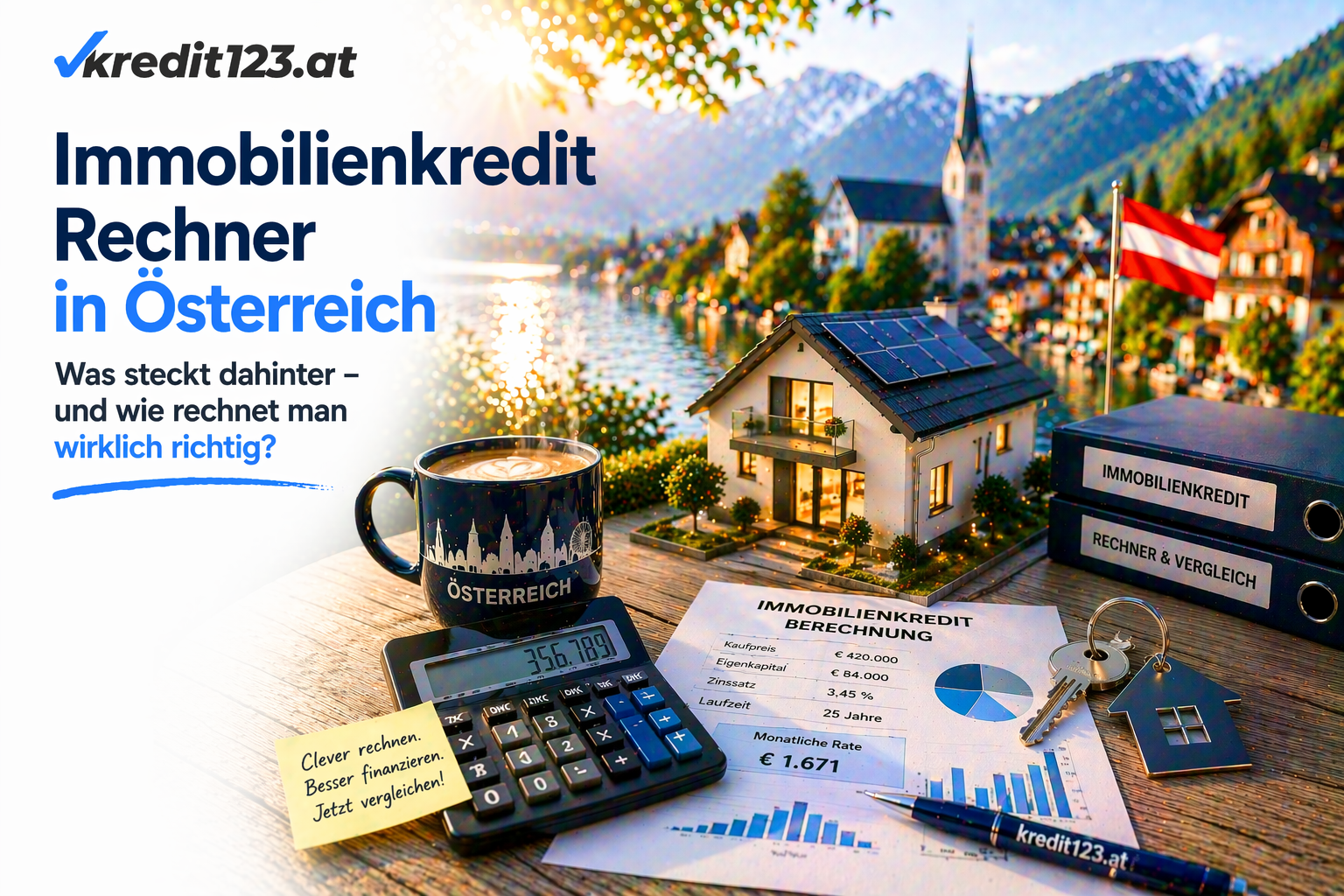
Mortgage Calculator Austria - The Ultimate Guide for Expats
Mortgage Calculator Austria: What's behind it – and how to calculate correctly. A loan calculator provides a monthly installment in seconds. This is practical but can be misleading if not fully informed. This article explains how mortgage calculators work, crucial inputs, common mistakes, and how to create a reliable financial plan for your property loan in Austria.
Read more
Buying Property in Austria for Families in 2026: Leveraging an Inheritance
Buying Property in Austria for Families in 2026: With a small inheritance or family support, you can achieve homeownership. Learn how to leverage these funds for your expat mortgage in Austria.
Read more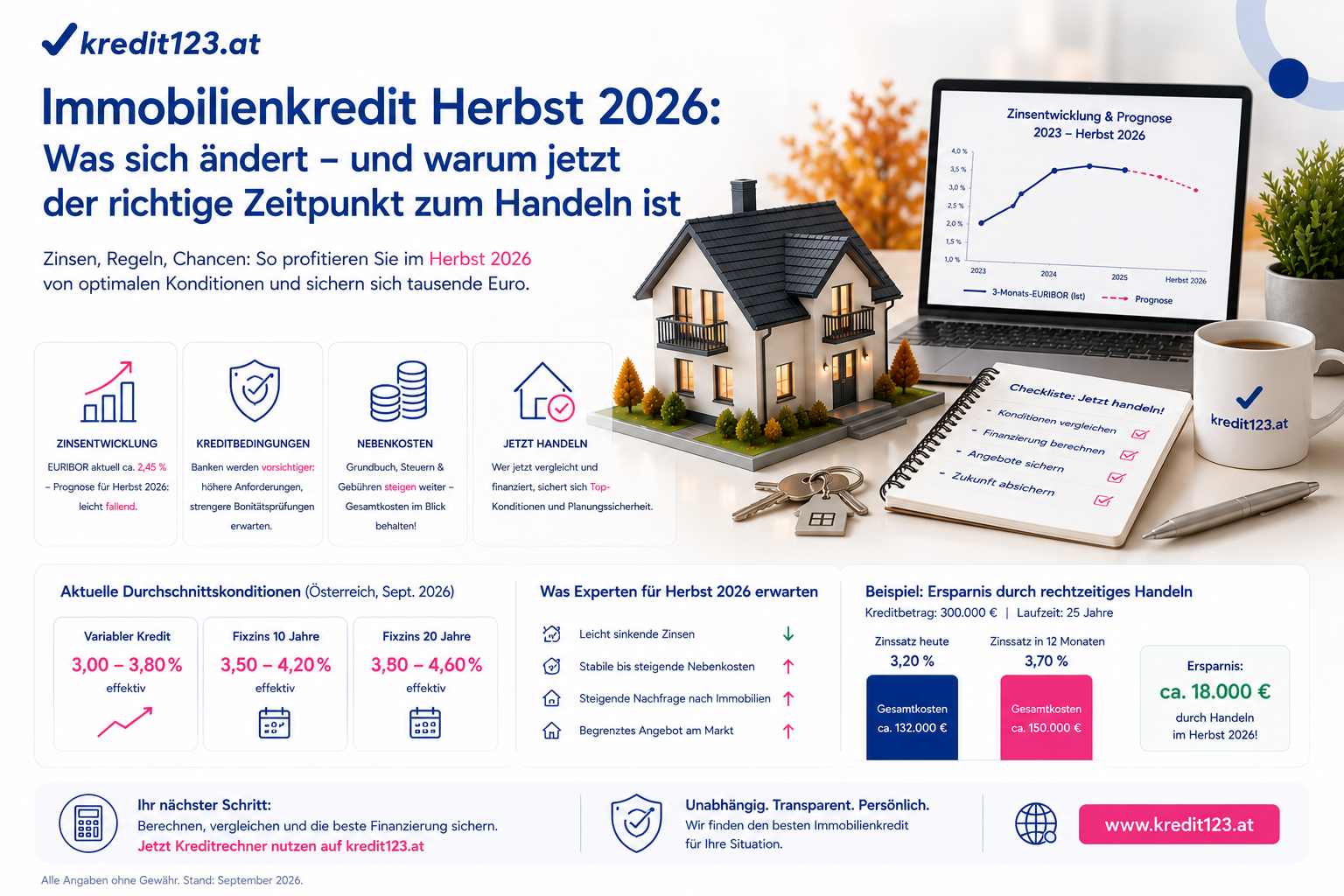
ECB Interest Rate Decision Sept. 2026: Implications for Home Loans in Austria
ECB Interest Rate Decision September 2026: What it means for your property loan in Austria. Stay informed about EURIBOR, current mortgage rates, and how to optimize your expat mortgage.
Read moreQuestions about your financing?
Our experts advise you personally and find the optimal solution for your property financing in Austria.