
Finding an Affordable Mortgage in Austria: 11 Tips to Save Money
Finding an affordable mortgage in Austria: 11 ways that really save money. A mortgage runs for 20 to 30 years. If you accept an interest rate that is 0.3% too high at the outset, you could easily pay 15,000 to 25,000 Euros more than necessary over the loan term. This guide shows specifically where savings can be made for your expat mortgage.
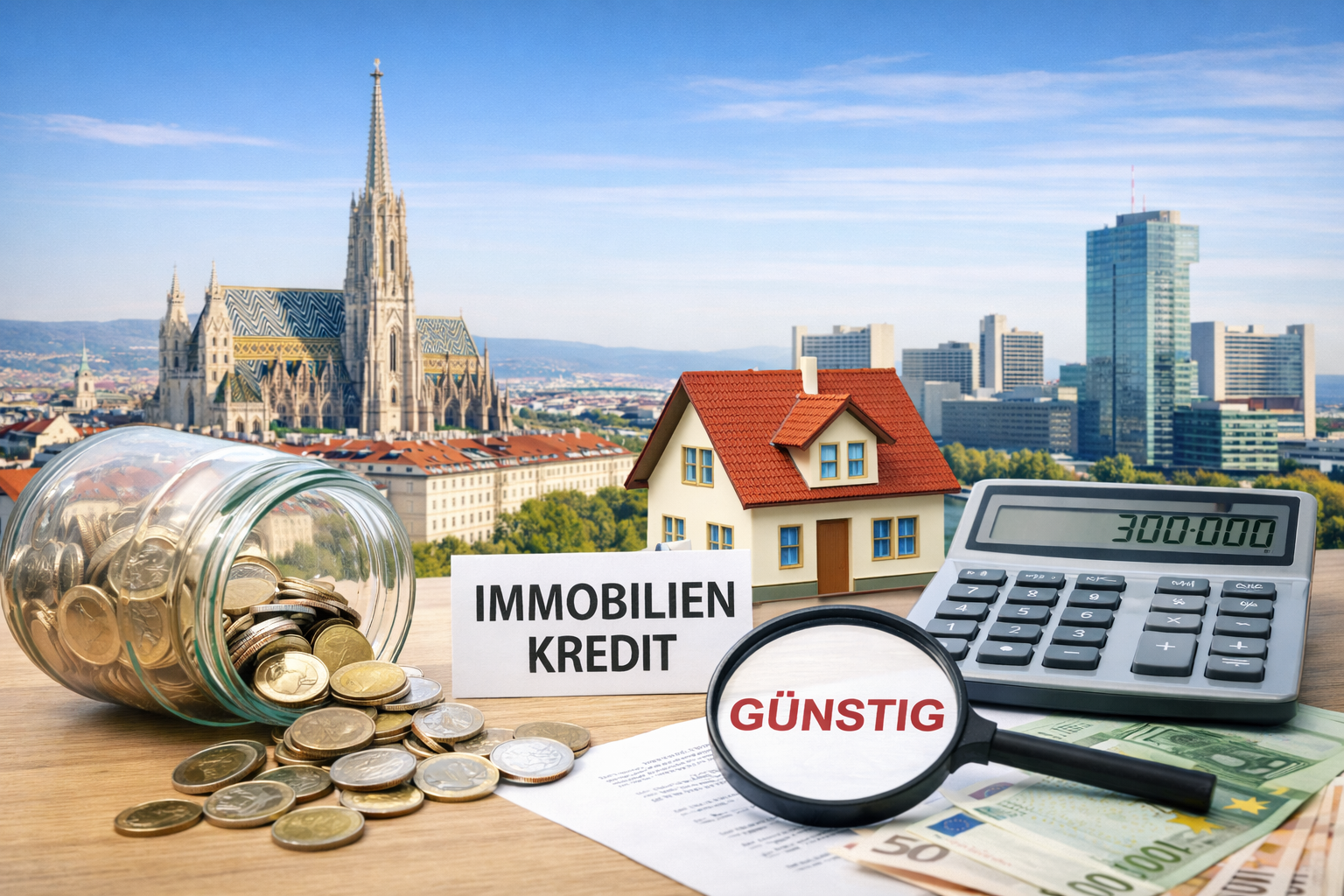
Finding an Affordable Mortgage in Austria: 11 Ways That Really Save Money
A mortgage in Austria typically runs for 20 to 30 years. If you accept an interest rate that is just 0.3% too high at the outset, you could easily pay 15,000 to 25,000 Euros more than necessary over the loan term. This guide specifically shows where savings can be made — not with vague tips, but with practical levers that truly make a difference. Before you start, use our Mortgage Comparison Calculator to get a feel for current market interest rates.
1. Understand the Difference Between Nominal Interest, Effective Interest, and Total Costs
The most common mistake when comparing loans: people compare the nominal interest rate — the pure interest — and overlook that two loans with identical nominal interest rates can still be differently expensive.
The nominal interest rate is the base interest rate on which monthly interest payments are calculated.
The effective interest rate (also known as the effective annual interest rate) is legally mandated and additionally includes ongoing fees such as account management and processing costs. It is a better comparison value — but still incomplete.
The total costs over the loan term are the only honest comparison criterion. This includes all interest, all fees, and all ancillary costs.
Two loans with identical effective interest rates but different terms will have massively different total costs. In addition, there are costs that do not appear in any of these three values: the Grundbuch (land registry) entry fee (1.2% of the loan amount), appraisal fee (500 to 1,500 Euros), and notary fees. If you want to save money when you buy property in Austria, you need to keep an eye on all cost blocks — not just the interest rate on the first page of the offer.
2. Never Ask Just One Bank — Comparison is the Biggest Lever
This sounds obvious, but it isn't. According to market observations, many Austrian property buyers obtain their mortgage Austria offer from their house bank — and accept it because the relationship is familiar.
The problem: The house bank has no incentive to make the best offer if it knows that no comparison is being made. The margin — i.e., the bank's surcharge on the reference interest rate — is negotiable. If you go back to your house bank with a competing offer, you will often get better conditions.
Example Calculation: Savings Potential Through Interest Comparison
Loan | Interest Rate (effective) | Term | Monthly Payment | Total Costs |
|---|---|---|---|---|
Bank A Offer | 4.2 % | 25 Years | €1,308 | €392,400 |
Bank B Offer | 3.7 % | 25 Years | €1,243 | €372,900 |
Difference | 0.5 % | - | €65 / Month | €19,500 |
Example calculation based on a €250,000 loan volume. Without guarantee, for illustrative purposes of the leverage effect. 0.5% sounds like little. €19,500 over the term sounds like more. Use the loan calculator on kredit123.at to quickly calculate different scenarios for your expat mortgage.
3. Know the Bank's Margin and Negotiate Strategically
Austrian mortgages with variable interest rates consist of two components: the EURIBOR (a reference interest rate that no bank controls) and the bank's margin (the surcharge that the bank keeps for itself).
The EURIBOR is fixed — it applies equally to everyone. The margin is negotiable. A margin of 0.8% is cheaper than 1.2%. And a margin that is contractually agreed upon remains constant throughout the entire term — even if the EURIBOR rises or falls. This makes the margin the most important negotiable parameter for a variable loan.
For fixed-rate loans, there is no explicit margin — the fixed interest rate includes everything. But here too, different institutions have different calculations, and anyone who obtains several fixed-rate offers will quickly see that the market does not have uniform prices. How to negotiate? Specifically: Present a cheaper offer from another institution as a basis for negotiation. Banks do not want to lose customers — often there is more leeway than expected when you buy property Austria.
4. Use Equity Strategically — More Than 20% Pays Off
The KIM-Regulation mandates a minimum of 20% equity. But the minimum is not the optimum. The higher the equity share, the lower the Loan-to-Value ratio (LTV) — the proportion of the loan to the property value. And the lower the LTV, the lower the risk for the bank, and generally the better the conditions for your mortgage Austria.
Impact of Equity on Conditions
Equity Share | LTV (Loan-to-Value) | Typical Condition Advantage |
|---|---|---|
20 % (KIM-V Minimum) | 80 % | Basic Conditions |
25–30 % | 70–75 % | Often 0.1–0.2 % better margin |
35–40 % | 60–65 % | Often 0.2–0.4 % better margin |
Over 40 % | Under 60 % | Best Conditions |
Important: Do not use all your equity. A liquidity buffer of three to six months' salary should remain after the purchase — for unexpected repairs, job changes, or other life events.
5. Choose the Right Loan Term — Longer is Not Automatically Better
A longer term reduces the monthly payment — that's the obvious advantage. The less obvious disadvantage: The total interest costs increase significantly.
Loan Volume | Interest Rate | Term | Monthly Payment | Total Interest |
|---|---|---|---|---|
€250,000 | 3.8 % | 20 Years | €1,488 | €107,120 |
€250,000 | 3.8 % | 25 Years | €1,287 | €136,100 |
€250,000 | 3.8 % | 30 Years | €1,165 | €169,400 |
Illustrative example calculation, without guarantee.
The difference between 20 and 30 years: €62,280 in additional costs with an identical interest rate. However, the monthly payment decreases by €323. The optimal term depends on how much monthly burden you can and want to bear. If you can easily manage the monthly payment, a shorter term will be cheaper in the long run for your expat mortgage.
6. Contractually Secure the Right to Special Repayments — and Then Use It
The right to special repayments (Sondertilgungsrecht) allows you to make unscheduled payments and thus reduce the outstanding debt. Every special repayment directly reduces the remaining debt on which interest is calculated. A special repayment of €10,000 at an interest rate of 3.8% saves approximately €4,000 to €5,000 in interest over 15 remaining years.
Typical provisions in Austrian loan agreements:
Special repayment possible at any time: Rare, but some banks offer this.
Up to €10,000 per year: Often possible with variable loans without surcharge.
End of fixed interest period: Often the only free option for long fixed-rate loans.
Prepayment penalty (Vorfälligkeitsentschädigung): If no agreement exists, early repayment becomes expensive.
If you know that an inheritance or a bonus is expected in a few years, you should definitely bring up the right to special repayments as a negotiation point for your mortgage Austria.
7. Choose the Right Time for Fixed vs. Variable Interest
This decision is not a matter of taste — it has measurable financial consequences.
When is a variable loan cheaper? If the EURIBOR is low or continues to fall, a variable loan starts cheaper and remains so as long as interest rates do not rise. In a phase of falling or stable ECB interest rates — as currently in 2026 — the argument for variable is stronger.
When is a fixed-rate loan cheaper? If interest rates are at a historically low level and an increase is likely, a fixed rate secures favorable conditions for the entire fixed period.
The hybrid model as a compromise: 10 to 15 years fixed, then variable — combines medium-term planning security with long-term flexibility. For most Austrian households, this is a sensible choice that limits interest rate risk for their expat mortgage.
8. Strategically Utilize State Subsidies and Housing Subsidies (Wohnbauförderung)
Austrian property buyers have access to subsidy programs that can significantly reduce overall costs. Each federal state (Bundesland) provides low-interest loans or grants.
Federal State | Subsidy Focus | Typical Form |
|---|---|---|
Vienna | New construction, renovation | Low-interest loan |
Lower Austria | Owner-occupied home, renovation | Loans from 1% interest |
Styria | Owner-occupied home, eco-points | Annuity subsidy |
Upper Austria | New construction, renovation | Loan, grant |
Important: Subsidy applications must generally be submitted before construction begins or the contract is signed. If you only think about it afterwards, you lose the claim.
9. Factor in Ancillary Costs from the Start
A common planning error: ancillary costs are underestimated. Use our ancillary cost calculator to gain clarity when you buy property Austria.
Cost Type | Amount (approx.) | Basis |
|---|---|---|
Real Estate Transfer Tax (Grunderwerbsteuer) | 3.5 % | Purchase Price |
Land Registry Entry (Grundbucheintragung) | 1.1 % + 1.2 % | Purchase Price / Loan |
Notary / Lawyer | 1.0–2.0 % | Purchase Price |
Brokerage Fee (Maklercourtage) | max. 3.6 % | Purchase Price incl. VAT |
For a purchase price of €350,000, this means €28,000 to €42,000 in ancillary costs — in addition to the equity. This is crucial for your expat mortgage planning.
10. Use an Independent Mortgage Broker
An independent mortgage broker does not work for a bank, but for the borrower. They compare offers from a wide range of institutions and know the current conditions for a home loan in Austria.
Access to exclusive offers
No negative impact on KSV score (credit rating) from multiple inquiries
Professional preparation of documents
Negotiation in the client's interest
In Austria, remuneration is legally regulated (HIKrG). If you save €15,000 to €20,000 over the term through better conditions, you will benefit immensely from this expertise when seeking an expat mortgage.
11. Regularly Review Existing Loans
Saving on your mortgage Austria doesn't end with signing the contract. If you have an ongoing loan, you should check every two to three years whether the conditions are still competitive. A loan refinancing comparison often helps here.
Renegotiation: If the current interest rate is above the market average, the margin can be renegotiated. Refinancing: If your house bank does not negotiate, switching to another bank may be worthwhile. Refinancing usually pays off with a remaining debt of €100,000 and an interest rate difference of 0.5%.
Checklist: Before Making a Loan Decision
Compared effective interest and total costs
Obtained at least three offers
Optimized equity ratio
Contractually agreed upon right to special repayments
All ancillary costs considered in the budget
Checked state subsidies
Consciously decided between fixed and variable interest
Conclusion: Saving on Your Mortgage is Not a Matter of Luck
The most affordable mortgages in Austria are obtained through preparation, comparison, and negotiation. The biggest levers are equity, margin negotiation, and choosing the right loan term. By considering these points, you can easily save €20,000 to €40,000 when you buy property Austria.
Inquire About Property Financing Now Without Obligation
Would you like to know how much you can save on your mortgage Austria? Our experts compare over 100 banks in Austria for you.
Useful Tools for Your Financing
Related Articles

Buying Property in Austria for Families in 2026: Leveraging an Inheritance
Buying Property in Austria for Families in 2026: With a small inheritance or family support, you can achieve homeownership. Learn how to leverage these funds for your expat mortgage in Austria.
Read more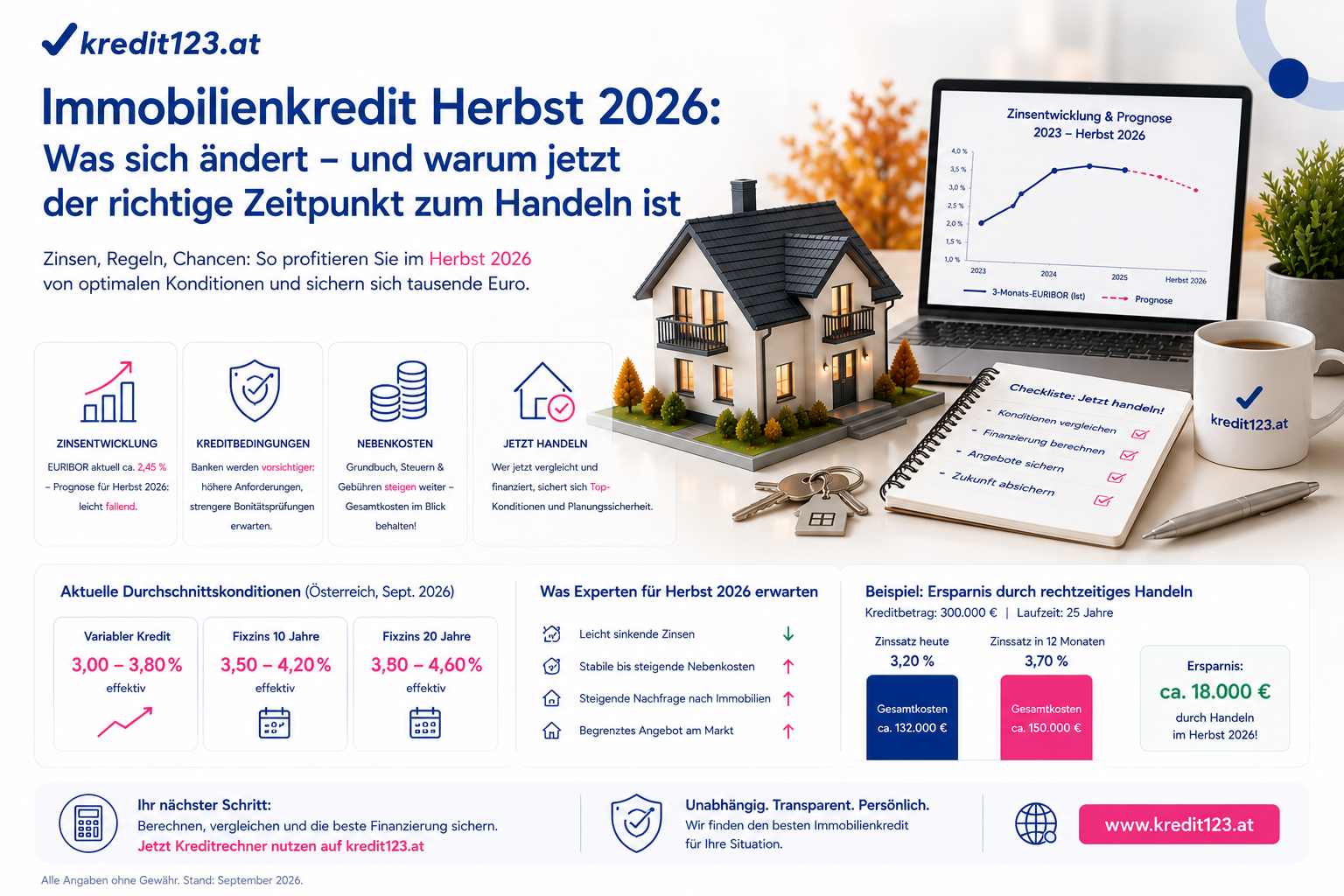
ECB Interest Rate Decision Sept. 2026: Implications for Home Loans in Austria
ECB Interest Rate Decision September 2026: What it means for your property loan in Austria. Stay informed about EURIBOR, current mortgage rates, and how to optimize your expat mortgage.
Read more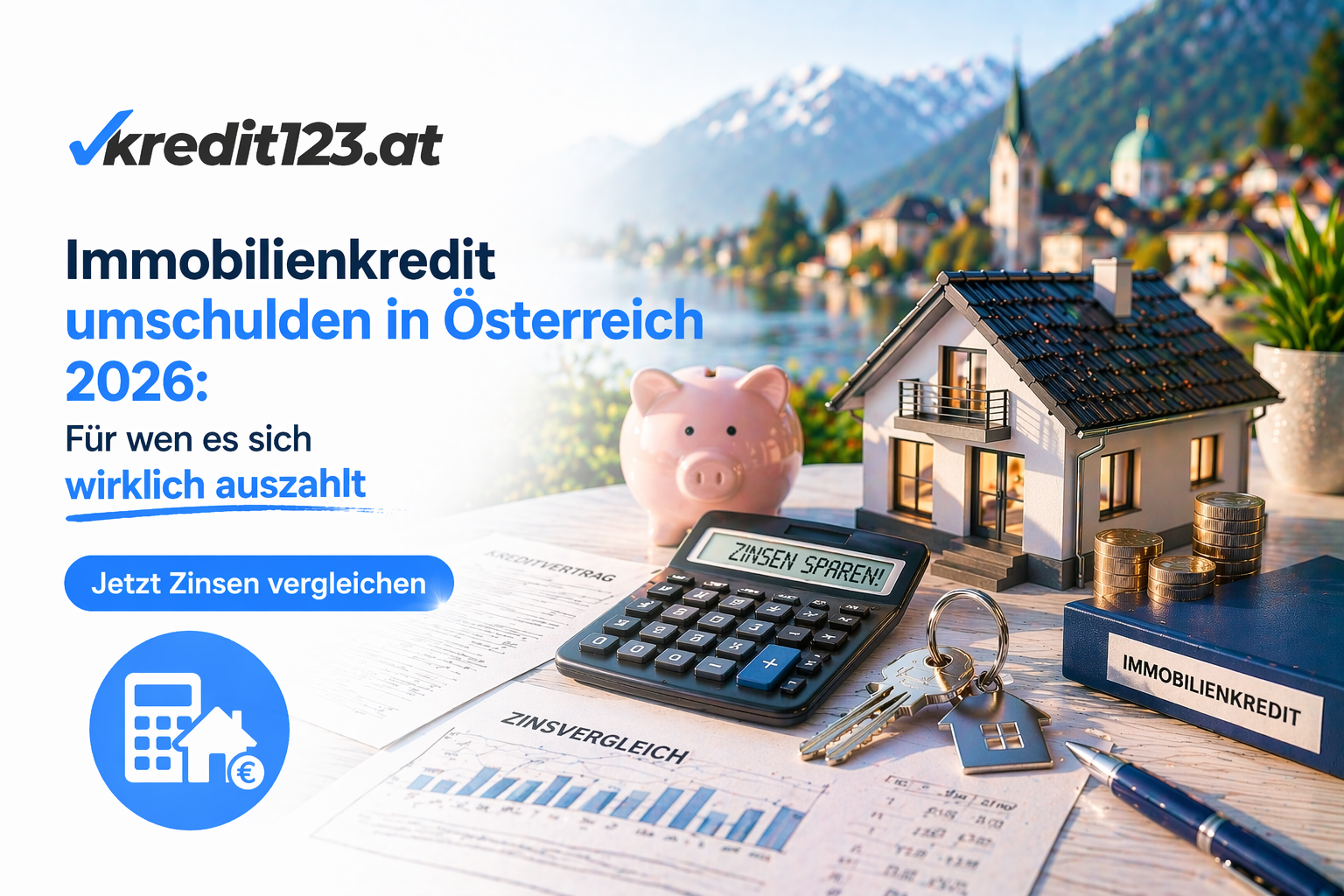
Immobilienkredit umschulden Österreich 2026: Zinsen & Tipps
Immobilienkredit umschulden in Österreich 2026: Für wen es sich wirklich auszahltkredit123.at · Ratgeber · Thema: Umschuldung Immobilienkredit Österre...
Read moreQuestions about your financing?
Our experts advise you personally and find the optimal solution for your property financing in Austria.